Today's
EarthStation1.com 15% (Or More!) Off Commemorative Memorial Title
: The Historical View A Legacy In Pictures JPG Image Set CD
Download USB
Today, July 1, 2026
July 1: Chronology: Calendars: The Months
Of The Year: -- July begins, the seventh month of the year in the
Julian and Gregorian calendars, the latter being the most widely
used calendar in the world. It was named by the Roman Senate in
honour of Roman general, statesman and dictator Julius Caesar
(July 12 or 13 100 BC - March 15, 44 BC), being the month of his
birth. Before then it was called Quintilis, being the fifth month
of the calendar that started with March. A member of the First
Triumvirate, Gaius Julius Caesar led the Roman armies in the
Gallic Wars before defeating his political rival Pompey in a civil
war. He subsequently became dictator from 49 BC until his
assassination in 44 BC. Caesar played a critical role in the
events that led to the demise of the Roman Republic and the rise
of the Roman Empire. July's length is 31 days. July succeeds June
and precedes August. July is on average the warmest month in most
of the Northern Hemisphere, where it is the second month of
summer, and the coldest month in much of the Southern Hemisphere,
where it is the second month of winter. The second half of the
year commences in July. In the Southern Hemisphere, July is the
seasonal equivalent of January in the Northern hemisphere. "Dog
days" are considered to begin in early July in the Northern
Hemisphere, when the hot sultry weather of summer usually starts.
Spring lambs born in late winter or early spring are usually sold
before July 1. July's birthstone is the ruby, which symbolizes
contentment. Its birth flowers are the larkspur and the water
lily. The zodiac signs are Cancer (until July 22) and Leo (July 23
onward). On Sale @ 15% Off Discount Till Midnight PT!
https://store.earthstation1.com/the-historical-view-a-legacy-in-pictures-jpg-photo-cd.html
Today's
EarthStation1.com 15% (Or More!) Off Commemorative Memorial Title:
TV Commercials: The Classics Vol. 4 DVD, Video Download, USB Drive
Today, July 1, 2026
July 1: National Creative Ice Cream
Flavors Day: -- Isn't it fitting to celebrate ice cream and its
flavors at the start of summer? There's a famous jingle, "I
scream, you scream, we all scream for ice cream!", that comes
to mind when anyone thinks of this popular dessert. On this day,
forget the conventional flavors of chocolate, vanilla, and
strawberry, and take your taste buds on an adventure by
celebrating National Creative Ice Cream Flavors Day! When we hear
ice cream, we hear fun! Whether you're a kid or an adult, everyone
loves ice cream. Over the years, there have been a host of ice
cream flavors invented, some really delicious and some rather
weird. The United States has the largest worldwide consumption of
ice cream with an average person consuming 48 pints of ice cream
annually, and California is the largest producer of ice cream in
the United States. National Creative Ice Cream Flavors Day is
celebrated on the first day of National Ice Cream Month, which was
declared by President Ronald Reagan in 1984. Surely many people
think they have tried every commercially available flavor.
However, they might be mistaken! There are so many ice cream
flavors that it's almost impossible to keep track of them. Some
delicious creative flavors that have been invented are raspberry,
coconut, caramel, butter pecan, and so forth. Then there are some
absolutely crazy flavors out there like crocodile egg, octopus,
caramelized brown bread, shrimp, bacon, pizza, and garlic ice
cream. Ice cream comes in several varieties such as ordinary ice
cream, frozen custard, frozen yogurt, gelato, etc. There's even
fried ice cream, which is flash-fried to create a crunchy coating
while keeping the core cold. Before the 10th century though, ice
cream was made out of ice and not milk. While we now see a
universal love for ice cream, it was originally only reserved for
the elite. You can celebrate National Creative Ice Cream Flavors
Day by getting creative and making your own flavor or simply
tasting a flavor you swore you never would. On Sale @ 15% Off
Discount Till Midnight PT!
https://store.earthstation1.com/tv-commercials-the-classics-vol-4-dv4.html
Today's
EarthStation1.com 15% (Or More!) Off Commemorative Memorial Title:
Jean Shepherd Radio Shows All Known To Exist DVD, MP3 Download,
USB
Today, July 1, 2026
July 1: International Chicken Wing Day:
-- This day recognizes every type of chicken wing, whether it is
buffalo wings or different sauce varieties such as barbeque,
ranch, garlic, or parmesan - the list is endless. It strives to
give importance to chicken wings of all shapes, sizes, flavors,
types. What's most important is that you have a bucket of chicken
wings ready to be indulged in on this day. Believe it or not,
Americans have been celebrating a day dedicated to Chicken Wings
for over four decades! The former mayor of Buffalo, Stan Makowski,
officially declared International Chicken Wing Day back in 1977.
Many refer to chicken wings as 'Buffalo wings' as Buffalo was the
city of the original invention of this lip-smacking dish. The
actual birthplace of these Buffalo wings was Anchor Bar in
Buffalo, New York. The son of the bar's founder, Teressa
Bellissimo, wanted to treat his friends to a late-night fried
dish. He air-fried the wings reserved for soup stock and mixed
them with a yummy sauce - and this led to the creation of the
modern-day Buffalo wings. However, on International Chicken Wing
Day, the limelight is on all kinds of wings. Chicken wings are
perfect when they are crispy on the outside with the meat inside
cooked all the way through while retaining its juices. The most
important element is the sauce, with hot sauce bringing out that
heat and sweet sauces being full of flavor. They are even served
with celery, carrots, or other crunchy veggies to provide a
balanced taste palate. Chicken wings have gained exponential
popularity with chicken wing festivals mushrooming almost
everywhere. The National Buffalo Wing Festival remains the most
famous event. Several years after the inception of these chicken
wings, McDonald's, followed by KFC and Domino's Pizza, introduced
their own hot wings. Now Chicken Wings are not just eaten in the
U.S. but in all parts of the world such as Canada, India, Mexico,
Germany, Singapore, the United Kingdom, and many more. Who
wouldn't want an entire day dedicated to this dish that makes us
salivate as soon we hear the name! Famed raconteur Jean Shepherd's
radio show was sponsor for many years by a New York City Chinatown
Chinese restaurant whose speciality was chicken wings, as
mentioned at length throughout many of Jean's radio shows. On Sale
@ 15% Off Discount Till Midnight PT!
https://store.earthstation1.com/complete-jean-shepherd-radio-and-lp-collection-mp3-dvds-2-dis32.html
Today's
EarthStation1.com 15% (Or More!) Off Commemorative Memorial Title:
The Who: Who's Zoo 1974 MP3 Set Download Or MP3 CD
Today, July 1, 2026
July 1: American Zoo Day: -- Today is all
about bringing the importance of zoos to the forefront. While zoos
originally were small confined spaces that were more or less a
prison for animals, things changed over time as people became
educated regarding animal rights. Today, zoos in America are huge
and provide an environment that reflects the natural habitat of
the confined animal. This is why modern zoos perform a role of a
sanctuary rather than a place where animals are put on display. To
honor and celebrate American Zoo Day, we suggest you head out to
the nearest zoo and be prepared to see beautiful animal species
you may never have seen before. American Zoo Day is celebrated
every year on July 1 to mark the day the Philadelphia Zoo was
opened up to the public in 1874. What's so special about this zoo,
you ask? Well, it was America's first zoo. The charter of the zoo
was signed in 1859, but due to the Civil War, the zoo was not
opened to the public until much later. The Philadelphia Zoo is
also important since it focuses on the conservation of numerous
animal species. Today, the zoo houses over 1,300 animals. Though
zoos existed in numerous regions across the world since ancient
Egypt, it wasn't until the 19th century that the trend of opening
zoos took over the world. Unfortunately, initially, these
enclosures were formed for the purpose of entertainment and cared
less about the comfort and life spans of animals. However, after
World War II, zoos also became breeding places where animals close
to extinction were brought in. Believe it or not, zoos have played
a huge role in saving numerous threatened species from being wiped
off the face of this planet. For instance, there were only 50
Hawaiian geese left in Hawaii in 1947. Two of these geese were
housed in a sanctuary in England where they began to breed. Most
importantly, zoos and the exotic animals within their walls are
often studied by scientists who want to understand their behavior
and formulate ways in which better living conditions can be
created for mammals. Many of these studies have been published in
the 'Journal of Zoology' since 1830. On Sale @ 15% Off Discount
Till Midnight PT!
https://store.earthstation1.com/the-who-whos-zoo-1974-mp3-set-downlod-or-mp3-cd.html
Today's
EarthStation1.com 15% (Or More!) Off Commemorative Memorial Title:
Funny Business: A Stand Up Life Stand-Up Comedy MP4 Video Download
DVD
Today, July 1, 2026
July 1: International Joke Day: -- Why did the chicken cross the road? To get away from all the terrible jokes on Joke Day. Get out there and do your worst, and see if you can't get a few laughs. Do you think you're funny? The best way to get a feel for a country is to try to understand the humor. Laughter is a universally recognized expression of amusement, and joke-telling can become a professional gig for those that truly have a humorous touch. International Joke Day is the perfect day to let out all of the guffaw producing, or groan-inducing jokes you've collected over the years, sharing them with friends or any passerby you can get to listen to you. International Joke Day is not just a day for you to prove to everyone how funny you are. It is the perfect day for you to share laughs and to put a smile on people's faces, including your own. Whether you prefer to share jokes or you like to listen to them, this is a day that is all about smiling, laughing, and having fun, and who wouldn't want to be a part of a day like this? They say that laughter is the best medicine, and a lot of people would agree with this! After all, there are actually a lot of health benefits that are associated with laughing. Laughter draws people together in a manner that triggers healthy emotional and physical changes in the body. Laughter can help to protect you from the damaging impact of stress, diminish pain, boost mood, and strengthen your immune system. Nothing workers more dependably or quicker to bring your body and mind back into balance than a good old laugh. Humor keeps you alert, focused, and grounded, as well as connecting you to others, inspiring hope, and lightening your burden. It also helps you to forgive sooner and release anger too. You may have also heard that laughter is a good way to burn calories, and this is true too! Of course, this does not mean that you should replace going to the gym with laying on the sofa and watching your favorite comedian. However, one study concluded that you can brun around 40 calories if you laugh for between 10 and 15 minutes each day. Over the year, this could be enough to lose around four pounds! International Joke Day seems to have officially begun in the United States but whatever the origins of International Joke Day, it is clear that jokes themselves pre-date by hundreds and hundreds of years. The first joke is often attributed to the Greeks, specifically Palamedes, who is also credited with the invention of many other things. Greece also boasts the first comedy club, though its purpose was sharing jokes among friends rather than stand up performances as we have now. Jokes have likely been told since man first looked at himself in a pool of water and passed judgment on his own complexion, so it's a safe bet that people have been celebrating jokes for a long time. On Sale @ 15% Off Discount Till Midnight PT! https://store.earthstation1.com/fubustlistco.html
Today's
EarthStation1.com 15% (Or More!) Off Commemorative Memorial Title:
TV Commercials: The Classics Vol. 8 DVD, MP4 Download, USB Flash
Drive
Today, July 1, 2026
July 1: National U.S. Postage Stamp Day:
-- In recognition of the July 1, 1847 issuance of the first U.S.
postage stamp, National U.S. Postage Stamp Day is a yearly
recognition of the ease and simplicity with which we send and
receive mail. A stamp represents payment for the delivery of a
letter or a package. At that time, stamps were not required. A
letter could be mailed without a stamp and delivery paid for by
the recipient. In 1855, the postage stamp became mandatory.
Philately is the study of stamps and postal history. Stamps often
have a fascinating history. Everything from the inspiration and
the artist to the postal rate in a given year affects the value of
a stamp. Collectors look at quality and rarity as well. While the
digital age may have slowed the flow of snail mail, it doesn't
reduce the excitement associated with receiving a letter or a card
in the mail. A handwritten note in an envelope with a postage
stamp in the corner holds so much more charm than most of the
emails people receive. A colorful postcard from an exotic location
or missive with crayon-drawn artwork improves one's day when it
comes delivered by a familiar postal worker. Birthday wishes that
come via text message or social media are one thing, but an
unexpected delivery through the mail in a bright envelope brings
more smiles than all the likes in the world. To oberve U.S.
Postage Stamp Day: Put a stamp on it! Celebrate the day by mailing
a letter or postcard to someone you know; Start a stamp
collection; Design your own stamp and post your designs and
collections on social media, using #USPostageStampDay. =========
July 1: National Postal Worker Day: -- stablished July 1, 1997 by
Seattle-area postal carriers to honor fellow employees, National
Postal Worker Day recognizes postal workers all across the United
States, and encourages the public they serve to show their
appreciation. Thank the numerous men and women who work
consistently and diligently to deliver all of our mail. These
employees suffer some of the harshest working conditions, yet
continue to persevere six days a week. Across the United States,
postal workers walk an average of 4 to 8 miles carrying a full
load of letters and packages, delivering them promptly to each of
our doorsteps. Approximately 490,000 postal workers across the
United States head out each day to our residences and businesses.
Regardless of the weather, postal workers deliver all week long.
Even when temperatures fluctuate from extreme heat and cold, the
mail arrives. In the rain, sleet and blizzards, too, the mail gets
delivered. Besides severe weather, dealing with unusual packages
is also part of the job. In 1913, the postal service started
delivering packages up to a maximum of 11 pounds. The most
surprising package to arrive for delivery was a small child.
Barely under the weight limit, James Beagle was mailed. For a cost
of 15 cents, a postal worker delivered young Beagle to his
grandmother just a few miles away. This practice continued for
just over a year. By then, the postmaster general put regulations
in place prohibiting it. While celebrating the day, take time to
thank your local postal worker. Encourage others to get the word
out and to focus on making every postal worker's day just a little
bit better. Contact the postal service and let them know how much
you appreciate postal workers and the work they do. On social
media, use #NationalPostalWorkerDay to give a shout-out to your
favorite postal worker. Whether they deliver, sort, or keep things
organized, July 1st is their day. ========= July 1: ZIP Code Day:
-- July 1, 1963: ZIP codes are introduced for United States mail.
They rolled out a publicity campaign that featured Mr. Zip,
encouraging people to use the new codes. Another element of the
campaign included mailing more than 72,000,000 postcards to let
people know about their new ZIP code. At this point in our lives,
a ZIP code may seem like a normal thing to have, but there was a
time when it did not exist. It was London and Liverpool in England
that were the first cities to be divided into designated ZIP code
sectors. However, by the end of World War I, this system began
making its way all across the world. In different countries, it
might be known by different names, though, such as postal code or
pin code. Some counties do not use a postal code at all, however,
such as the Bahamas, Botswana, Dominica, Fiji, Ghana, Mauritius,
Yemen, to name a few. The ZIP code or the zone improvement plan
system only came to the United States in the early 1960s. The idea
behind introducing it was to help in speedy mail travel. It was
observed that mail was moving more efficiently when there were ZIP
codes added to the final address. The usage of a ZIP code has now
gone beyond its initial purpose and includes collecting
geographical statistics, credit card authorization, internet
routing, identification of legislative districts,
insurance-related works, and more. The term 'ZIP code' was first
registered by the United States Postal Service. Since 1967, the
post office has made it mandatory to use ZIP codes for bunk
mailers. ZIP codes are even popular in pop culture. The most
famous ZIP code is 90210 in Beverly Hills, owing to the '90s TV
show of the same name. On Sale @ 15% Off Discount Till Midnight
PT!
https://store.earthstation1.com/tv-commercials-the-classics-vol-8-dv8.html
Today's
EarthStation1.com 15% (Or More!) Off Commemorative Memorial Title:
Television Broadcasting History Films MP4 Video Download DVD Set
Today, July 1, 2026
July 1: National Television Heritage Day:
-- Can you believe that we have been watching T.V. for over 100
years now? It seems strange that we have been sitting in front of
a plastic box and being entertained for more than a century. In
fact, as of 2011, 96.7% of households in the United States own a
television set, with some owning multiple T.V. sets, in their
lounges and their bedrooms. These days, we need the Internet to
stream shows, and everything is released at the same time; no more
waiting for the next episode the following week. These
technological changes inspire many people to go back to basics.
Television was first available in the late 1920s, but it took
several years before the new technology was marketed to consumers.
Following WWII, improved black-and-white television broadcasting
gained popularity in the United Kingdom and the United States,
which launched the popularity of T.V.s and their presence in homes
and offices. In the beginning, television was almost exclusively
used to influence public opinion in the 1950s, for example, when
even commercials were advertising propaganda. It wasn't until the
1960s that color broadcasting was introduced in the United States.
From then on, the way we watch T.V. has evolved so much that we
can now watch our favorite television shows on our phones or
tablets while in the car, in bed, or in public spaces. The content
that is shown on T.V. has also grown exponentially since the late
1960s and 70s with movie rentals through television networks, live
T.V. events, and the rise of videotape, D.V.D.s and Blu- rays, and
of course, smart T.V.s that can host a variety of online platforms
like Netflix, Hulu, Amazon Prime. There is also much more content
readily available that it has become impossible to keep up with
everything that is shown on T.V.! We have changed the way we
consume media since the invention of the television, and we have
seen significant changes in society and cultures around the world.
With technology and T.V. evolving so frequently, people wanted to
remember where it all started; back in the 1950s, when there were
a handful of regular T.V. programming and easily digestible
volumes of entertainment. ========= July 1, 1966: The first color
television transmission in Canada takes place from Toronto.
========= July 1, 1958: The Canadian Broadcasting Corporation
links television broadcasting across Canada via microwave. On Sale
@ 15% Off Discount Till Midnight PT!
https://store.earthstation1.com/television-broadcast-history-dual-layer-dvd.html
Today's
EarthStation1.com 15% (Or More!) Off Commemorative Memorial Title:
Challenge Of The Yukon Old Time Radio Series MP3 Set DVD Download
USB
Today, July 1, 2026
July 1: Canada Day: -- A day for all
those who celebrate Canada as their home and native land celebrate
Canada Day! The day commemorates the July 1, 1867 enactment of The
British North America Act Of 1867, in which the Provinces of
Canada, New Brunswick, and Nova Scotia joined into confederation
to create the modern nation of Canada. On July 1, 1980, "O
Canada" officially became the national anthem of Canada in
honor of this event! Until 1982, Canada celebrated Dominion Day as
their national holiday. The day was then renamed 'Canada Day.' The
history of Canada isn't splattered with a ton of wars and
bloodshed, unlike many other countries. Throughout the mid-1800s,
the possibility of unification between the British North American
colonies was discussed. On July 1, 1867, the British Parliament
brought the British North America Act into effect, leading to the
creation of independent Canada. The territories within the
dominion consisted of Upper and Lower Canada, Nova Scotia, and New
Brunswick. Through this act, Canada was divided into Quebec and
Ontario, allowing provisions for neighboring colonies to join in
the future. This is how present-day Canada came into formation.
The British North America Act served as the constitution for
Canada until 1982. Dominion Day was established in 1879 but wasn't
celebrated by many Canadians, as they still identified themselves
as British citizens. This changed on the 50th anniversary of the
confederation in 1917, when Dominion Day started becoming more
popular. A bill was forwarded in 1946 to rename Dominion Day, but
the passing of the bill was stalled due to disagreement in the
House of Commons over what the new name should be. In 1967, on the
100th anniversary of the nation's creation, there was an
increasing interest in Canadian patriotism, and celebrations
really took off. Even before it became official, citizens would
refer to the holiday as Canada Day, and the name was finally
adopted in 1982. On Sale @ 15% Off Discount Till Midnight PT!
https://store.earthstation1.com/challenge-of-the-yukon-mp3-dvd-complete-radio-broadcast3.html
Today's
EarthStation1.com 15% (Or More!) Off Commemorative Memorial Title:
Bob Marley And The Wailers (1986) Documentary MP4 Video Download
DVD
Today, July 1, 2026
July 1: International Reggae Day: -- This
music genre finds its roots etched in Jamaica and is an integral
part of the country's culture. Reggae is a mix of rhythm and
blues, calypso, African, and Latin American music. The music is
characterized by a heavy four-beat rhythm, which is carried out by
drums, congas, bass guitars, and electric guitars. Reggae music
also uses a scraper, which is a corrugated stick that the musician
rubs with a plain stick. International Reggae Day is an annual
event celebrated in Kingston, Jamaica. It appreciates this style
of music that was brought into the world by the Caribbean. While
it started there, it eventually spread into every corner of the
world and struck a chord with music lovers with its easy and
relaxed rhythm. This musical holiday was founded by Andrea Davis
to create an annual global reggae party. She envisaged such an
event after a visit to Kingston in 1991. Whilst there, she heard a
speech by Winnie Mandela on the inspiration reggae music has given
to the people of South Africa in their fight against apartheid.
Thus, the very first International Reggae Day was held on July 1,
1994. Many people now express that reggae music has truly served
as a voice for the oppressed and an emotional outlet. Born in
Jamaica, reggae music is now especially popular in the United
States, Great Britain, and Africa. This music genre has seen some
great personalities taking it to new heights and making it
extremely popular. The renowned Bob Marley and the Wailers are
considered the most iconic reggae artists ever, owing to their
efforts in bringing reggae music to the international stage.
International Reggae Day is celebrated with much gusto and fanfare
keeping the spirit of the music intact. The event sees thousands
of fans and musicians flocking to the country from different parts
of the world to celebrate the amazing history of reggae music, its
people, and its culture. On Sale @ 15% Off Discount Till Midnight
PT!
https://store.earthstation1.com/bob-marley-and-the-wailers-dvd-1986-documen1986.html
Today's
EarthStation1.com 15% (Or More!) Off Commemorative Memorial Title:
TV Music & Dance Shows #5 Ready Steady Go! DVD, Download,
Flash Drive
Today, July 1, 2026
( #JCKaelin here: To my mind, this is the
greatest hero of American music. So much of what my youthful
white-boy 1960s rock 'n' roll reality of "cool" was
based either partly or entirely on him - and practically none of
my generation even know his name - so it's left to me and those
like me with their eyes, ears and hearts open enough to do
something about it!) ========= July 1, 1915: #BOTD: #HBD! Willie
Dixon, African American blues guitarist, bassist, singer,
songwriter, arranger and record producer, widely considered
history's most influential blues artist, who sang with a
distinctive voice, but is best known as one of the most prolific
songwriters of his time (d. January 29, 1992) is #born William
James Dixonin Vicksburg, Mississippi. Next to Muddy Waters, Dixon
is recognized as the most influential person in shaping the
post-World War II sound of the Chicago blues. Dixon's songs have
been recorded by countless musicians in many genres as well as by
various ensembles in which he participated. A short list of his
most famous compositions includes "Hoochie Coochie Man",
"I Just Want to Make Love to You", "Little Red
Rooster", "My Babe", "Spoonful", and "You
Can't Judge a Book by the Cover". These songs were written
during the peak years of Chess Records, from 1950 to 1965, and
were performed by Muddy Waters, Howlin' Wolf, Little Walter, and
Bo Diddley; they influenced a generation of musicians worldwide.
Dixon was an important link between the blues and rock and roll,
working with Chuck Berry and Bo Diddley in the late 1950s. His
songs have been covered by some of the most successful musicians
of the past sixty years including Bob Dylan and Jimi Hendrix. Jeff
Beck, Cream, The Doors, Led Zeppelin, The Rolling Stones and
Steppenwolf all featured at least one of his songs on their debut
albums, a measure of his influence on rock music. He received a
Grammy Award and was inducted into the Blues Hall of Fame, The
Rock And Roll Hall Of Fame, and the Songwriters Hall of Fame.
Dixon was inducted into the Blues Hall of Fame in 1980, in the
inaugural session of the Blues Foundation's ceremony. In 1989 he
received a Grammy Award for his album Hidden Charms. Dixon's
health increasingly deteriorated during the 1970s and the 1980s,
primarily as a result of long-term diabetes. Eventually one of his
legs was amputated. Dixon died of heart failure in Burbank,
California, aged 76. He is buried in Burr Oak Cemetery, in Alsip,
Illinois. After his death, his widow, Marie Dixon, took over the
Blues Heaven Foundation and moved the headquarters to Chess
Records. Dixon was posthumously inducted into The Rock And Roll
Hall Of Fame in the category Early Influences (pre-rock) in 1994.
On April 28, 2013, both Dixon and his grandson Alex Dixon were
inducted into the Chicago Blues Hall of Fame.In 2007, Dixon was
honored with a marker on the Mississippi Blues Trail in Vicksburg.
The actor and comedian Cedric the Entertainer portrayed Dixon in
Cadillac Records, a 2008 film based on the early history of Chess
Records. In 2020, Rolling Stone ranked him as the 12th greatest
bass player and mentioned him as the history's most influential
bluesmen. On Sale @ 15% Off Discount Till Midnight PT!
https://store.earthstation1.com/classic-tv-music-amp-dance-shows-5-ready-steady-go-dv5.html
Today's
EarthStation1.com 15% (Or More!) Off Commemorative Memorial Title:
WABC Radio Airchecks MP3 Collection 1960s-1980s DVD, MP3 Download,
USB
Today, July 1, 2026
( #JCKaelin here: I was 11 when this came
out, and already had a girlfriend. A perfect musical accompaniment
to my first taste of love :) ) July 1, 1972: Record Releases: --
The Raspberries release their hit single Go All The Way. Written
by guitarist of the American rock group the Raspberries Eric
Carmen (writer and performer of "All by Myself," "Never
Gonna Fall in Love Again," "She Did It," "Hungry
Eyes," and "Make Me Lose Control") for their 1972
album Raspberries, the song reached the Top 5 on three principal
US charts: number 5 on the Billboard Hot 100, number 4 on Cashbox,
and number 3 on Record World. The single sold more than 1.3
million copies, earning the band their only certified Gold Record.
It was their second single release and their biggest US hit.
Because of its sexually suggestive lyrics, "Go All the Way"
was banned by the BBC, limiting its success in the United Kingdom.
Carmen has stated that the inspiration for the song was the
Rolling Stones' "Let's Spend the Night Together." He
said that "I wanted to write an explicitly sexual lyric that
the kids would instantly get but the powers that be couldn't pin
me down for." He also said that to try to avoid being
censored he "turned it around so that the girl is encouraging
the guy to go all the way, rather than the stereotypical thing of
the guy trying to make the girl have sex with him. I figured that
made me seem a little more innocent." Carmen got the title
from Dan Wakefield's novel Going All the Way; when he saw the
book, "[he] realized it would make a sensational song title."
Carmen wrote much of the song alone at the piano, but lead
guitarist Wally Bryson believed that he should have received a
songwriting credit for coming up with its famous intro guitar
riff. Engineer Shelly Yakus employed heavy dynamic range
compression from a prototype limiter on the song in order to
increase the power of the music. Allmusic critic Mark Deming
called it "among the finest records ever made about one of
the key subjects in rock & roll - convincing your girlfriend
to have sex with you," saying that it "merges smooth
harmony parts and an easygoing melody with hook-laden breaks and a
guitar figure that Pete Townshend would have been happy to have
dreamed up." Rolling Stone critic Dave Marsh called it a
"[ringer] for Paul McCartney." Music journalist Ken
Sharp noted that the song's "subversive lyrics were cleverly
masked in a G-rated package" and that the lyrics are unusual
in that "the girl in the song's chorus is pleading with her
boyfriend to do her." Carmen said that his approach was
"let's start it out like The Who, but when we get to the
questionable part we will do it like choir boys and maybe they
won't notice. Ultimate Classic Rock critic Dave Swanson described
how the song reflects various influences and merges them into a
new type of song: "The opening Who-like blast leads into a
very Beatles-esque verse, before landing in some forgotten Beach
Boys chorus." Cash Box said that "mighty guitar riffs
explode on impact" and the song has "a touch of the
Badfinger sound." Record World said that "its effective
combination of hard rock and top 40 stylings make this a natural
for playlists of virtually every format." Wichita Beacon
critic Paul Baker compared the song's guitar riff to that of
Free's "All Right Now." Swanson rated it as the
Raspberries' greatest song and "the definitive power pop song
of all time." Classic Rock History critic Brian Kachejian
concurred, praising the melody and arrangement and calling it "an
iconic pop gem." Kachejian also noted that "The way the
verse transcends into the song's chorus riding on the wings of
Eric Carmen's legendary lead vocal is one for the ages."
Sharp rated it the Raspberries' third best song, calling it a
"'Power Pop How To' manual all wrapped up in three explosive
minutes and unquestionably one of the most seminal pop singles
ever." Steve Sullivan wrote in the Encyclopedia of Great
Popular Song Recordings that the opening guitar riff is one of the
best in rock, saying that it "still has the capacity to
startle and thrill more than four decades later." The tune
ranked at number 33 on the Billboard Year-End Top 100 of 1972 and
number 39 on Cashbox's year-end best-sellers countdown. In 1989,
Spin magazine named "Go All the Way" in its list of the
"100 Greatest Singles of All Time", ranking it at number
91. "Go All the Way" appeared in Blender magazine's July
2006 issue as one of its "Greatest Songs Ever".
#Powerpop #HardRock #Top40 #RockMusic #RockSky #MP3 #DVD
#AudioDownload On Sale @ 15% Off Discount Till Midnight PT!
https://store.earthstation1.com/wabc-musicradio-shows-mp3-dvd-60s80s-am-360807775.html
Today's
EarthStation1.com 15% (Or More!) Off Commemorative Memorial Title:
Global Rivals: History Of Cold War w/Marvin Kalb DVD, MP4, USB
Drive
Today, July 1, 2026
July 1, 1991: The Aftermath Of World War
II: The Cold War: The Cold War (1985-1991) (The End Of The Cold
War): Intergovernmental Organizations: International
Organizations: Military Alliances: The Cold War: The Treaty Of
Friendship (The Warsaw Pact): -- The Warsaw Pact is officially
dissolved at a meeting in Prague, Czechoslovakia as Czechoslovak
President Vaclav Havel formally ends the treaty. As the last acts
of the Cold War had playing out, several Warsaw Pact states
(Poland, Czechoslovakia, and Hungary) had participated in the
US-led coalition effort to liberate Kuwait in the Gulf War, and on
February 25, 1991, the Warsaw Pact was declared disbanded at a
meeting of defence and foreign ministers from remaining Pact
countries meeting in Hungary. The Warsaw Pact had been formed on
May 14, 1955, when eight Communist bloc countries, including the
Soviet Union, joined The Warsaw Treaty Organization: (WTO) as they
signed The TreatyOof Friendship, a mutual defense treaty. The
Warsaw Treaty Organization was a collective defense treaty signed
in Warsaw, Poland, between the Soviet Union and seven other
Eastern Bloc socialist republics of Central and Eastern Europe -
Albania, Bulgaria, Czechoslovakia, East Germany, Hungary, Poland,
Romania and Soviet Union in total. The Warsaw Pact was the
military complement to the Council For Mutual Economic Assistance
(CoMEcon), the regional economic organization for the socialist
states of Central and Eastern Europe. The Warsaw Pact was created
in reaction to the integration of West Germany into NATO in 1955
as per the London and Paris Conferences of 1954. Dominated by the
Soviet Union, the Warsaw Pact was established as a balance of
power or counterweight to NATO. There was no direct military
confrontation between the two organisations; instead, the conflict
was fought on an ideological basis and in proxy wars. Both NATO
and the Warsaw Pact led to the expansion of military forces and
their integration into the respective blocs. Its largest military
engagement was the Warsaw Pact Invasion Of Czechoslovakia in
August 1968 (with the participation of all Pact nations except
Albania and Romania), which, in part, resulted in Albania
withdrawing from the Pact less than a month later. The Pact began
to unravel with the spread of the Revolutions Of 1989 through the
Eastern Bloc, beginning with the Solidarity movement in Poland,
its electoral success in June 1989 and the Pan-European Picnic in
August 1989. East Germany withdrew from the Pact following German
reunification in 1990. On February 25, 1991, at a meeting in
Hungary, the Pact was declared at an end by the defense and
foreign ministers of the six remaining member states. The USSR
itself was dissolved in December 1991, although most of the former
Soviet republics formed the Collective Security Treaty
Organization shortly thereafter. In the following 20 years, the
Warsaw Pact countries outside the USSR each joined NATO (East
Germany through its reunification with West Germany; and the Czech
Republic and Slovakia as separate countries), as did the Baltic
states which had been part of the Soviet Union. On Sale @ 15% Off
Discount Till Midnight PT!
https://store.earthstation1.com/global-rivals-history-of-cold-war-w-mavin-kalb-dvd-mp4-usb-driv4.html
Today's
EarthStation1.com 15% (Or More!) Off Commemorative Memorial Title:
Heart Of The Dragon TV Series DVD, Video Download, USB Flash Drive
Today, July 1, 2026
( #JCKaelin here: BIG MISTAKE!!!!! :( )
========= July 1, 1997: China: The History Of China: The History
Of Hong Kong: China-United Kingdom Relations: Decolonization:
British Decolonization: British Decolonization Of China: The
Handover Of Hong Kong (Traditional Chinese: Xianggang Huigui,
"Hong Kong's Return"): -- The United Kingdom transfers
sovereignty over Hong Kong to the People's Republic of China was
at midnight on 1 July 1997. This event ended 156 years of British
rule in the former colony, which began in 1841. The handover
ceremony is attended by British Prime Minister Tony Blair;
Charles, Prince Of Wales; Chinese President Jiang Zemin; and U.S.
Secretary Of State Madeleine Albright. Hong Kong was established
as a special administrative region of China (SAR) for 50 years,
maintaining its own economic and governing systems from those of
mainland China during this time, although influence from the
central government in Beijing increased after the passing of the
Hong Kong national security law in 2020. Hong Kong had been a
colony of the British Empire since 1841, except for four years of
Japanese occupation from 1941 to 1945. After the First Opium War,
its territory was expanded in 1860 with the addition of Kowloon
Peninsula and Stonecutters Island, and in 1898, when Britain
obtained a 99-year lease for the New Territories. The date of the
handover in 1997 marked the end of this lease. The 1984
Sino-British Joint Declaration had set the conditions under which
Hong Kong was to be transferred, with China agreeing to maintain
existing structures of government and economy under a principle of
"one country, two systems" for a period of 50 years.
Hong Kong became China's first special administrative region; it
was followed by Macau after its transfer from Portugal in 1999
under similar arrangements. With a 1997 population of about 6.5
million, Hong Kong constituted 97 percent of the total population
of all British Dependent Territories at the time and was one of
the United Kingdom's last significant colonial territories. Its
handover marked the end of British colonial prestige in the
Asia-Pacific region where it had never recovered from the Second
World War, which included events such as the sinking of Prince of
Wales and Repulse and the Fall of Singapore, as well as the
subsequent Suez Crisis after the war. The transfer, which was
marked by a handover ceremony attended by Charles, Prince of Wales
(now King Charles III) and broadcast around the world, is often
considered to mark the definitive end of the British Empire.
========= ( #JCKaelin here: SEE?!?!?!?!?! BIG MISTAKE!!!!! :( )
========= July 1, 2003: China: The History Of China: The History
Of Hong Kong: Political Repression: Political Repression In China:
Political Repression In Hong Kong: Censorship: Censorship In
China: Censorship In Hong Kong: National Security (Legislative
Provisions) Bill 2003 (Traditional Chinese: Guojia Anquan (Lifa
Biaowen) Tiaoli Cao'an): -- Over 500,000 people protest against
efforts to pass anti-sedition legislation in Hong Kong. The
National Security (Legislative Provisions) Bill was aimed to amend
the Crimes Ordinance, the Official Secrets Ordinance and the
Societies Ordinance pursuant to the obligation imposed by Article
23 of the Basic Law of the Hong Kong Special Administrative Region
of the People's Republic of China and to provide for related,
incidental and consequential amendments. The proposed bill caused
considerable controversy in Hong Kong and a massive demonstration
on July 1, 2003. In the aftermath, James Tien resigned from the
Executive Council and the bill was withdrawn after it became clear
that it would not get the necessary support from the Legislative
Council for it to be passed. The bill was then shelved
indefinitely. China's National People's Congress imposed a
national security law with similar language (though without the
treason component) on Hong Kong on June 30, 2020, citing its
authority under Article 18 of the Basic Law. A second attempt at
implementing the article has undergone the legislative process.
The bill was officially passed on March 19, 2024 and came into
effect on March 23, 2024. On Sale @ 15% Off Discount Till Midnight
PT!
https://store.earthstation1.com/heart-of-the-dragon-dvds-post-mao-china-all-12-tv-shows-3-di123.html
Today's
EarthStation1.com 15% (Or More!) Off Commemorative Memorial Title:
Berlin: The Doomed City + Bonus Germany Reunification MP4 Download
DVD
Today, July 1, 2026
July 1, 1990: The Aftermath Of World War
II: The Cold War: The Cold War (1985-1991) (The End Of The Cold
War): The Dissolution Of The Soviet Union: The Revolutions Of 1989
(The Fall Of Nations, The Autumn Of Nations, The Fall Of
Communism): The Eastern Bloc (The Communist Bloc, The Socialist
Bloc, The Soviet Bloc): The Eastern Bloc (The Communist Bloc, The
Socialist Bloc, The Soviet Bloc): German Reunification (German:
Deutsche Wiedervereinigung): -- East Germany accepts the Deutsche
Mark as its currency, thus uniting the economies of East and West
Germany. The Deutsche Mark (German: "German Mark"),
abbreviated "DM" or "D-Mark", was the official
currency of West Germany from 1948 until 1990 and later the
unified Germany from 1990 until the adoption of the euro in 2002.
In English, it was typically called the "Deutschmark".
One Deutsche Mark was divided into 100 pfennigs. It was first
issued under Allied occupation in 1948 to replace the Reichsmark
and served as the Federal Republic of Germany's official currency
from its founding the following year. On December 31, 1998, the
Council of the European Union fixed the irrevocable exchange rate,
effective January 1, 1999, for German mark to euros as DM 1.95583
= 1 EU. In 1999, the Deutsche Mark was replaced by the euro; its
coins and banknotes remained in circulation, defined in terms of
euros, until the introduction of euro notes and coins on January
1, 2002. The Deutsche Mark ceased to be legal tender immediately
upon the introduction of the euro-in contrast to the other
eurozone states, where the euro and legacy currency circulated
side by side for up to two months. Mark coins and banknotes
continued to be accepted as valid forms of payment in Germany
until 1 March 2002. The Deutsche Bundesbank has guaranteed that
all German marks in cash form may be changed into euros
indefinitely, and one may do so in person at any branch of the
Bundesbank in Germany. Banknotes and coins can even be sent to the
Bundesbank by mail. In 2012, it was estimated that as many as 13.2
billion marks were in circulation, with one poll from 2011 showing
a narrow majority of Germans favouring the currency's restoration
(although only a minority believed this would bring any economic
benefit). Newer polls indicate that only a minority of Germans is
supportive of a reintroduction of the Deutsche Mark. On Sale @ 15%
Off Discount Till Midnight PT!
https://store.earthstation1.com/berlin-the-doomed-city-dvd-cities-at-war-wwii-germany.html
Today's
EarthStation1.com 15% (Or More!) Off Commemorative Memorial Title:
Frontiers Of Flight Aviation History TV Series DVD, MP4, USB Drive
Today, July 1, 2026
July 1, 1931: Aviation: The History Of
Aviation: Aviation Firsts: Circumnavigation: Circumnavigation Of
The Earth: Aerial Circumnavigation Of The Earth: -- Wiley Post and
Harold Gatty become the first people to circumnavigate the globe
in a single-engined monoplane aircraft, the Lockheed Vega. In
1930, the record for flying around the world was not held by a
fixed-wing aircraft, but by the Graf Zeppelin, piloted by Hugo
Eckener in 1929 with a time of 21 days. On June 23, 1931, Post and
the Australian navigator Harold Gatty left Roosevelt Field on Long
Island, New York, in the Winnie Mae with a flight plan that would
take them around the world, stopping at Harbour Grace, Flintshire,
Hanover twice, Berlin, Moscow, Novosibirsk, Irkutsk,
Blagoveshchensk, Khabarovsk, Nome (where his propeller had to be
repaired), Fairbanks (where the propeller was replaced), Edmonton,
and Cleveland before returning to Roosevelt Field. They arrived
back on July 1, after traveling 15,474 miles (24,903 km) in the
record time of 8 days and 15 hours and 51 minutes, in the first
successful aerial circumnavigation by a single-engined monoplane.
The reception they received rivaled Charles Lindbergh's everywhere
they went. They had lunch at the White House on July 7, rode in a
ticker-tape parade the next day in New York City, and were honored
at a banquet given by the Aeronautical Chamber of Commerce of
America at the Hotel Astor. After the flight, Post acquired the
Winnie Mae from F.C. Hall, and he and Gatty published an account
of their journey titled Around the World in Eight Days, with an
introduction by Will Rogers. On Sale @ 15% Off Discount Till
Midnight PT!
https://store.earthstation1.com/frontiers-of-flight-aviation-history-tv-series-dvd-mp4-download-us4.html
Today's
EarthStation1.com 15% (Or More!) Off Commemorative Memorial Title:
The Divided Union: American Civil War TV Series DVD, MP4, USB
Drive
Today, July 1, 2026
July 1, 1862: The American Civil War (The
Civil War, The War Between The States): The Eastern Theater Of The
American Civil War: The Peninsula Campaign (The Peninsular
Campaign): The Seven Days Battles (The Seven Days Campaign): The
Battle Of Malvern Hill (The Battle Of Poindexter's Farm): -- The
final battle of The Seven Days Battles takes place between the
Confederate Army of Northern Virginia, led by Gen. Robert E. Lee,
and the Union Army of the Potomac under Maj. Gen. George B.
McClellan, on a 130-foot (40 m) elevation of land known as Malvern
Hill near the Confederate capital of Richmond, Virginia and just
one mile (1.6 km) from the James River. More than fifty thousand
soldiers from each side took part, using more than two hundred
pieces of artillery and three warships. The Union's V Corps,
commanded by Brig. Gen. Fitz John Porter, took up positions on the
hill on June 30. McClellan was not present for the initial
exchanges of the battle, having boarded the ironclad USS Galena
and sailed down the James River to inspect Harrison's Landing,
where he intended to locate the base for his army. Confederate
preparations were hindered by several mishaps. Bad maps and faulty
guides caused Confederate Maj. Gen. John Magruder to be late for
the battle, an excess of caution delayed Maj. Gen. Benjamin Huger,
and Maj. Gen. Stonewall Jackson had problems collecting the
Confederate artillery. The battle occurred in stages: an initial
exchange of artillery fire, a minor charge by Confederate Brig.
Gen. Lewis Armistead, and three successive waves of Confederate
infantry charges triggered by unclear orders from Lee and the
actions of Maj. Gens. Magruder and D. H. Hill, respectively. In
each phase, the effectiveness of the Federal artillery was the
deciding factor, repulsing attack after attack, resulting in a
tactical Union victory. In the course of four hours, a series of
blunders in planning and communication had caused Lee's forces to
launch three failed frontal infantry assaults across hundreds of
yards of open ground, unsupported by Confederate artillery,
charging toward firmly entrenched Union infantry and artillery
defenses. These errors provided Union forces with an opportunity
to inflict heavy casualties. The Seven Days Battles were the
climax of the Peninsula Campaign, during which McClellan's Army of
the Potomac sailed around the Confederate lines, landed at the tip
of the Virginia Peninsula, southeast of Richmond, and struck
inland towards the Confederate capital. Confederate general Joseph
E. Johnston fended off McClellan's repeated attempts to take the
city, slowing Union progress on the peninsula to a crawl. When
Johnston was wounded, Lee took command and launched a series of
counterattacks, collectively called the Seven Days Battles. These
attacks culminated in the action on Malvern Hill. Despite the
Union army's victory, the battle did little to alter the outcome
of the Peninsula Campaign: after the battle, McClellan and his
forces withdrew from Malvern Hill to Harrison's Landing, where he
remained until August 16. His plan to capture Richmond had been
thwarted. The Confederate press heralded Lee as the savior of
Richmond. In stark contrast, McClellan was accused of being absent
from the battlefield, a harsh criticism that haunted him when he
ran for president in 1864. On Sale @ 15% Off Discount Till
Midnight PT!
https://store.earthstation1.com/the-divided-union-american-civil-war-tv-series-3-dual-layer-dvd3.html
Today's
EarthStation1.com 15% (Or More!) Off Commemorative Memorial Title:
The Battle Of Gettysburg Civilians DVD MP4 Download USB Flash
Drive
Today, July 1, 2026
July 1, 1863: The American Civil War (The
Civil War, The War Between The States): The Eastern Theater Of The
American Civil War: The Gettysburg Campaign: The Battle Of
Gettysburg: -- Elements of the Union and Confederate armies
accidentally collide at Gettysburg when North Carolinians under
Confederate Brig. Gen. J. Johnston Pettigrew went ot Gettysburg
looking for shoes, unintentionally beginning The Battle Of
Gettysburg. Confederate General Lee urgently concentrated his
forces there, his objective being to engage the Union army and
destroy it. Low ridges to the northwest of town were defended
initially by a Union cavalry division under Brig. Gen. John
Buford, and soon reinforced with two corps of Union infantry.
However, two large Confederate corps assaulted them from the
northwest and north, collapsing the hastily developed Union lines,
sending the defenders retreating through the streets of the town
to the hills just to the south. The Battle Of Gettysburg was
fought July 1-3, 1863, in and around the town of Gettysburg,
Pennsylvania, by Union and Confederate forces during the American
Civil War. The battle involved the largest number of casualties of
the entire war and is often described as the war's turning point.
Union Maj. Gen. George Meade's Army Of The Potomac defeated
attacks by Confederate Gen. Robert E. Lee's Army Of Northern
Virginia, halting Lee's invasion of the North. After his success
at Chancellorsville in Virginia in May 1863, Lee led his army
through the Shenandoah Valley to begin his second invasion of the
North-the Gettysburg Campaign. With his army in high spirits, Lee
intended to shift the focus of the summer campaign from
war-ravaged northern Virginia and hoped to influence Northern
politicians to give up their prosecution of the war by penetrating
as far as Harrisburg, Pennsylvania, or even Philadelphia. Prodded
by President Abraham Lincoln, Maj. Gen. Joseph Hooker moved his
army in pursuit, but was relieved of command just three days
before the battle and replaced by Meade. The day after the two
armies collided on at Gettysburg on July 1, most of both armies
had assembled. The Union line was laid out in a defensive
formation resembling a fishhook. In the late afternoon of July 2,
Lee launched a heavy assault on the Union left flank, and fierce
fighting raged at Little Round Top, the Wheatfield, Devil's Den,
and the Peach Orchard. On the Union right, Confederate
demonstrations escalated into full-scale assaults on Culp's Hill
and Cemetery Hill. All across the battlefield, despite significant
losses, the Union defenders held their lines. On the third day of
battle, fighting resumed on Culp's Hill, and cavalry battles raged
to the east and south, but the main event was a dramatic infantry
assault by 12,500 Confederates against the center of the Union
line on Cemetery Ridge, known as Pickett's Charge. The charge was
repulsed by Union rifle and artillery fire, at great loss to the
Confederate army. Lee led his army on a torturous retreat back to
Virginia. Between 46,000 and 51,000 soldiers from both armies were
casualties in the three-day battle, the most costly in US history.
On November 19, President Lincoln used the dedication ceremony for
the Gettysburg National Cemetery to honor the fallen Union
soldiers and redefine the purpose of the war in his historic
Gettysburg Address. On Sale @ 15% Off Discount Till Midnight PT!
https://store.earthstation1.com/the-battle-of-gettysburg-civilians-dvd-mp4-download-usb-flash-driv4.html
Today's
EarthStation1.com 15% (Or More!) Off Commemorative Memorial Title:
Spanish-American War & Cuban War Of Independence DVD,
Download, USB
Today, July 1, 2026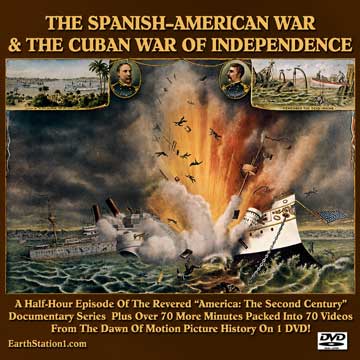
July 1, 1898: The Decolonization Of The
Americas: The Cuban War Of Independence (The Necessary War): The
Spanish-American War: The Battle Of San Juan Hill (Spanish:
Batalla De Las Colinas De San Juan) (The Battle For The San Juan
Heights): -- In the bloodiest and most famous battle of the war,
as well as the greatest victory for the 1st United States
Volunteer Cavalry, better known by their nickname of the Rough
Riders, as claimed by the press and its new commander, Theodore
Roosevelt, who was to eventually become first vice president and
then president, then posthumously awarded the Medal of Honor in
2001 for his actions in Cuba, the only U.S. president to receive
the award, American forces under the command of William Rufus
Shafter and Joseph Wheeler assault a Spanish force led by Arsenio
Linares y Pombo on Kettle Hill and San Juan Hill, which together
form San Juan Heights in Santiago De Cuba, outnumbering the
Spanish defenders 16-to-one, charging the heights and dispersing
the Spanish after suffering heavy casualties. The battle proved to
be one of the most significant battles of the war and, along with
The Siege Of Santiago, a decisive battle in deciding the fate of
the United States Army campaign in Cuba. The names San Juan Hill
and Kettle Hill were given to the location by the Americans.
Tensions between Spain and the United States worsened over Spanish
behavior during their efforts to quell the Cuban War of
Independence, with many Americans being agitated by exaggerated
reports of Spanish atrocities against the Cuban population. In
January 1898, fearing the fate of American interests in Cuba due
to the war, the cruiser USS Maine was dispatched to protect them.
Less than a month later, the cruiser exploded while lying at
anchor in Havana harbor, killing 267 sailors onboard and inflaming
American opinion, with Spain being portrayed as the culprit in the
American media without conclusive evidence. Two months later, war
was declared. The Americans, after already landing troops in the
Battle of Guantanamo Bay, moved inland to seek a decisive
encounter with the Spanish forces. Both sides drew blood at the
Battle of Las Guasimas, with the Spanish moving to defend the
strategically valuable San Juan Heights from the Americans. A week
later, a significantly larger American force, including the famed
'Rough Riders', moved to clear the heights of the Spanish. After
enduring artillery fire which inflicted heavy casualties, the
Americans charged up the hill and dispersed the Spanish, suffering
even more heavily in the process. The Americans won another
engagement at El Caney the same day, with both battles
highlighting the bravery and skill of the American/Cuban forces,
as well as the Spanish defenders. Following the surrender of the
Spanish army at Santiago, they agreed to depart Cuba, ending over
four centuries of Spanish rule. On Sale @ 15% Off Discount Till
Midnight PT!
https://store.earthstation1.com/spanishamerican-war-films-dvd.html
Today's
EarthStation1.com 15% (Or More!) Off Commemorative Memorial Title:
Appointment With Destiny: Cortez and Montezuma + Aztec Bonus MP4
DVD
Today, July 1, 2026
June 30-July1, 1520: The Spanish
Colonization Of The Americas: Indigenous Rebellions In Mexico And
Central America: The Spanish Conquest Of The Aztec Empire (The
Conquest Of Mexico, The Spanish-Aztec War (1519-1521), The
Conquest Of Tenochtitlan): La Noche Triste (Spanish, "The
Night Of Sorrows", literally "The Sad Night"): --
Spanish conquistadors led by Hernan Cortes fight their way out of
Tenochtitlan in what became known as La Noche Triste ("The
Night of Sorrows", literally "The Sad Night"), an
important event during the Spanish conquest of Mexico. Cortes, his
conquistadors and native allies were driven out of the Mexican
capital at Tenochtitlan following the death of the Aztec king
Moctezuma II, who had been held hostage by the Spaniards. Various
sources give dates ranging from June 30 to July 4, a problem
further confounded by the use of the Julian calendar in Europe at
this time, which had diverged from the true (solar) date by almost
12 days. In June 1520, news from the Gulf coast reached Cortes
that a party of Spaniards much larger than his had been sent by
Governor Velazquez of Cuba to arrest Cortes for insubordination.
Leaving Tenochtitlan in the care of his trusted lieutenant, Pedro
de Alvarado, Cortes marched to the coast, where he defeated the
Cuban expedition led by Panfilo de Narvaez sent to capture him.
When Cortes told the defeated soldiers about the riches of
Tenochtitlan, they agreed to join him. Reinforced by Narvaez's
men, Cortes headed back to Tenochtitlan. During Cortes' absence,
Pedro de Alvarado in Tenochtitlan obtained information that the
Aztecs were planning to attack him. In response, de Alvarado
ordered a preemptive slaughter of Aztec nobles and priests
celebrating a festival in the city's main temple. In retaliation,
the Aztecs laid siege to the Spanish compound, in which Moctezuma
was still being held captive. By the time Cortes returned to
Tenochtitlan in late June, the Aztecs had elected a new Hueyi
Tlatoani (ruler) named Cuitlahuac. Cortes ordered Moctezuma to
address his people from a terrace in order to persuade them to
stop fighting and to allow the Spaniards to leave the city in
peace. The Aztecs, however, jeered at Moctezuma, and pelted him
with stones and darts. By Spanish accounts, he was killed in this
assault by the Mexica people, though the Mexica people claim he
had been killed instead by the Spanish. With Moctezuma dead,
Cortes and Alvarado knew they were in a precarious position. Under
constant attack, and with gunpowder, food, and water in short
supply, Cortes decided to break out of the city by night. In order
to put the Aztecs off their guard, he sent messengers asking for a
one-week ceasefire, at the end of which the Spaniards would return
any treasure of which they were in possession and would be
permitted to leave the city peacefully. Since the Aztecs had
damaged bridges on four of the eight causeways into the island
city, the Spaniards devised a portable bridge they could use in
order to cross any unspanned sections of water. Cortes ordered
that as much of the accumulated gold and other booty as was
feasible be packed and carried away, and invited the Spanish
soldiers to take and carry away as much as they wished of the
remainder. This invitation would lead to the demise of many
soldiers who, overburdened with treasure, found it impossible to
navigate the causeways and other obstacles encountered on the way
out of the city. On the night of July 1, 1520, Cortez's large army
left their compound and headed west, toward the Tlacopan causeway.
The causeway was apparently unguarded, and the Spaniards made
their way out of their complex unnoticed, winding their way
through the sleeping city under the cover of a rainstorm. Before
reaching the causeway, they were noticed by Aztec warriors known
as the Eagle Warriors, who sounded the alarm. First by a woman
drawing water, and then by the priest of Huitzilopochtli from atop
Templo Mayor. The fighting was ferocious. As the Spaniards and
their native allies reached the causeway, hundreds of canoes
appeared in the waters alongside to harry them. The Spaniards
fought their way across the causeway in the rain. Weighed down by
gold and equipment, some of the soldiers lost their footing, fell
into the lake, and drowned. Amid a vanguard of horsemen, Cortes
pressed ahead and reached dry land at Tacuba, leaving the rest of
the expedition to fend for itself in the treacherous crossing.
Seeing the wounded survivors straggle into the village, Cortes and
his horsemen turned back to the causeway, where they encountered
Pedro de Alvarado, unhorsed and badly wounded, in the company of a
handful of Spaniards and Tlaxcaltecas. According to Bernal Diaz
del Castillo, it was at this point that tears came to Cortes'
eyes, as he realized the extent of the debacle. Cortes, Alvarado
and the strongest and most skilled of the men had managed to fight
their way out of Tenochtitlan, although they were all bloodied and
exhausted. Cortes himself had been injured in the fighting. All of
the artillery had been lost, as had most of the horses. The
sources are not in agreement as to the total number of casualties
suffered by the expedition. Cortes himself claimed that 154
Spaniards were lost along with over 2,000 native allies. Thoan
Cano, another eyewitness to the event, said that 1170 Spaniards
died, but this number probably exceeds the total number of
Spaniards who took part in the expedition. Francisco Lopez de
Gomara, who was not himself an eyewitness, estimated that 450
Spaniards and 4,000 allies died. Montezuma's son, Chimalpopoca
(Moctezuma) was killed and the Tepanec prince Tlaltecatzin, King
Cacamatzin, his three sisters and two brothers were also killed.
Diaz states the Spaniards suffered 860 soldiers killed, which
included those from the later Battle Of Otumba. The Tlaxcaltecas
lost a thousand. The noncombatants attached to the expedition
suffered terribly, 72 casualties, including five Spanish women.
The few women who survived included La Malinche the interpreter,
Dona Luisa, and Maria Estrada. The event was named La Noche Triste
("The Night of Sorrows") on account of the sorrow that
Cortes and his surviving followers felt and expressed at the loss
of life and treasure incurred in the escape from Tenochtitlan.
Further battles awaited the Spaniards and their allies as they
fought their way around the north end of Lake Zumpango. One week
later, at the Battle Of Otumba, not far from Teotihuacan, they
turned to fight the pursuing Aztecs, decisively defeating them -
according to Cortes, because he slew the Aztec commander - and
giving the Spaniards a small respite that allowed them to reach
Tlaxcala. It was in Tlaxcala that Cortes plotted the siege of
Tenochtitlan and the eventual destruction of the Aztec Empire. On
Sale @ 15% Off Discount Till Midnight PT!
https://store.earthstation1.com/appointment-with-destiny-cortez-and-montezuma-dvd.html
Today's
EarthStation1.com 15% (Or More!) Off Commemorative Memorial Title:
The Great War (1964) TV Documentary Series DVD, Video Download,
USB
Today, July 1, 2026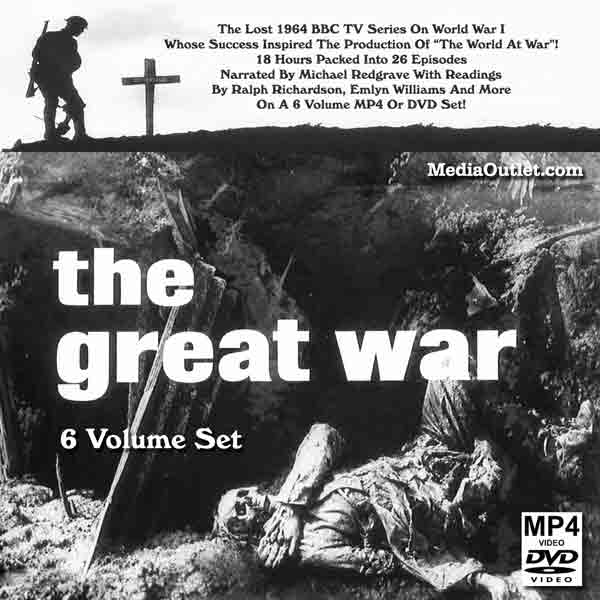
July 1, 1916: The European Civil War:
World War I: The First European War (The European Theater Of World
War I): The Western Front Of World War I: The Battle Of The Somme
(The Somme Offensive, The First Battle Of The Somme): The Battle
Of Albert (July 1-13, 1916): The First Day On The Somme: -- A
staggering 19,000 soldiers of the British Army are killed and
40,000 wounded on The First Day On The Somme, the opening day of
The Battle Of Albert (July 1-13), the name given by the British to
the first two weeks of the Battle Of The Somme. Nine corps of the
French Sixth Army, the British Fourth and the Third army, attacked
the German 2nd Army (General Fritz von Below) from Foucaucourt
south of the Somme northwards to Serre, north of the Ancre and at
Gommecourt, 2 mi (3.2 km) beyond, in the Third Army area. The
objective of the attack was to capture the German first and second
positions from Serre south to the Albert-Bapaume road and the
first position from the road south to Foucaucourt. The German
defence south of the road mostly collapsed and the French had
"complete success" on both banks of the Somme, as did
the British from Maricourt on the army boundary, where XIII Corps
took Montauban and reached all its objectives and XV Corps
captured Mametz and isolated Fricourt. The III Corps attack on
both sides of the Albert-Bapaume road was a disaster, making only
a short advance south of La Boisselle, where the 34th Division had
the largest number of casualties of any Allied division on July 1.
Further north, the X Corps attack captured the Leipzig Redoubt,
failed opposite Thiepval and had a great but temporary success on
the left flank, where the German front line was overrun by the
36th Ulster Division, which then captured Schwaben and Stuff
redoubts. German counter-attacks during the afternoon recaptured
most of the lost ground north of the Albert-Bapaume road and more
British attacks against Thiepval were costly failures. On the
north bank of the Ancre, the attack of VIII Corps was a disaster,
with large numbers of British troops being shot down in no man's
land. The VII Corps diversion at Gommecourt was also costly, with
only a partial and temporary advance south of the village. The
German defeats from Foucaucourt to the Albert-Bapaume road left
the German defence on the south bank incapable of resisting
another attack and a substantial German retreat began, from the
Flaucourt plateau to the west bank of the Somme close to Peronne,
while north of the Somme, Fricourt was abandoned overnight.
Several truces were observed to recover wounded from no man's land
on the British front, where the Fourth Army had lost 57,470
casualties, of whom 19,240 men were killed. The French had 1,590
casualties and the German 2nd Army lost 10,000-12,000 men. Orders
were issued to the Anglo-French armies to continue the offensive
on July 2 and a German counter-attack on the north bank of the
Somme by the 12th Division, intended for the night of July 1-2,
took until dawn on July 2 to begin and was destroyed. Since July 1
1916, the immense cost in lives of the battle and the "meagre
gains" provided have been a source of great grief and
controversy in Britain; however, in German and French writing, the
first day of the Battle Of The Somme has been little more than a
footnote to the even more massive losses of 1914-1915 and the
Battle Of Verdun. On Sale @ 15% Off Discount Till Midnight PT!
https://store.earthstation1.com/the-great-war-dvd-set-1964-wwi-tv-series-26-shows-1964266.html
Today's
EarthStation1.com 15% (Or More!) Off Commemorative Memorial Title:
Tank Battles: El Alamein, The Volga & Kursk + Bonus DVD MP4
Download
Today, July 1, 2026
July 1, 1942:The European Civil War:
World War II: The Second European War (The European Theater Of
World War II): The North African Campaign: The Western Desert
Campaign (The Desert War): The Battles Of El Alamein: The First
Battle Of El Alamein: -- At 03:00, the German 90th Light Infantry
Division begins The First Battle Of El Alamein by advancing east;
at about 10:00, the German 21st Panzer Division attacks Deir el
Shein. The 18th Indian Infantry Brigade - supported by 23
25-pounder gun-howitzers, 16 of the new 6-pounder anti-tank guns
and nine Matilda tanks - held out the whole day in desperate
fighting, but by evening the Germans succeeded in over-running
them. The time they bought allowed British General Auchinleck to
organise the defence of the western end of Ruweisat Ridge. The
British 1st Armoured Division intervened, and ran into 15th Panzer
Division just south of Deir el Shein and drove it west. By the end
of the day's fighting, the Afrika Korps had 37 tanks left out of
its initial complement of 55. By the early afternoon, the German
90th Light had extricated itself from the El Alamein box defences
and resumed its move east. It came under artillery fire from
Auchinleck's three South African brigade groups, and was forced to
dig in. The First Battle Of El Alamein was fought in Egypt between
Axis forces (Germany and Italy) of the Panzer Army Africa
(Panzerarmee Afrika) (also known as the Afrika Korps) commanded by
Field Marshal (Generalfeldmarschall) Erwin Rommel nicknamed "The
Desert Fox" and Allied (British Imperial and Commonwealth)
forces (Britain, British India, Australia, South Africa and New
Zealand) of the Eighth Army, commanded by General Claude
Auchinleck. The British prevented a second advance by the Axis
forces into Egypt. Axis positions near El Alamein, only 66 mi (106
km) from Alexandria, were dangerously close to the ports and
cities of Egypt, the base facilities of the Commonwealth forces
and the Suez Canal. However, the Axis forces were too far from
their base at Tripoli in Libya to remain at El Alamein
indefinitely, which led both sides to accumulate supplies for more
offensives, against the constraints of time and distance. It was
not until the Second Battle Of El Alamein of October 23 - November
4 1942 that the British were able to obtain an offensive victory
in the North African Campaign. On Sale @ 15% Off Discount Till
Midnight PT!
https://store.earthstation1.com/tank-battles-el-alamein-to-the-volga-and-battle-of-kursk-dvd.html
Today's
EarthStation1.com 15% (Or More!) Off Commemorative Memorial Title:
Moscow's Man: Kim Philby UK Double Agent For USSR DVD, Download,
USB
Today, July 1, 2026
July 1, 1963: Espionage: British Spies
For The Soviet Union: Double Agents: Spy Rings: The Cambridge
Five: -- The British Government admits that former diplomat Kim
Philby had worked as a Soviet agent by way of officially
confirming Philby's escape to Moscow. On the evening of January
23, 1963, Philby vanished from Beirut, failing to meet his wife
for a dinner party at the home of Glencairn Balfour Paul, First
Secretary at the British Embassy. The Dolmatova, a Soviet
freighter bound for Odessa, had left Beirut that morning so
abruptly that cargo was left scattered over the docks; Philby
claimed that he left Beirut on board this ship. However, others
maintain that he escaped through Syria, overland to Soviet Armenia
and thence to Russia. On July 30, Soviet officials announced that
they had granted him political asylum in the USSR, along with
Soviet citizenship. When the news broke, MI6 came under criticism
for failing to anticipate and block Philby's defection, though
Nicholas Elliott, an MI6 officer recently stationed in Beirut and
friend of Philby's who was tasked with attempting to secure
Philby's full confession, claimed he could not have prevented
Philby's flight. Journalist Ben Macintyre, author of several works
on espionage, speculated that MI6 might have left open the
opportunity for Philby to flee to Moscow to avoid an embarrassing
public trial. Philby himself thought this might have been the
case. Upon his arrival in Moscow in January 1963, Philby
discovered that he was not a colonel in the KGB, as he had been
led to believe. He was paid 500 roubles a month (the average
Soviet salary in 1960 was Rbls 80.60 a month and Rbls 122 in 1970)
and his family was not immediately able to join him in exile.
Philby was under virtual house arrest, guarded, with all visitors
screened by the KGB. It was ten years before he was given a minor
role in the training of KGB recruits. Mikhail Lyubimov, his
closest KGB contact, explained that this was to guard his safety,
but later admitted that the real reason was the KGB's fear that
Philby would return to London. Secret files released to the
National Archives in late 2020 indicated that the British
government had intentionally conducted a campaign to keep Philby's
spying confidential "to minimise political embarrassment"
and prevent the publication of his memoirs, according to a report
by The Guardian. Nonetheless, the information was publicized in
1967 when Philby granted an interview to Murray Sayle of The Times
in Moscow. Philby confirmed that he had worked for the KGB and
that "his purpose in life was to destroy imperialism".
Philby occupied himself by writing his memoirs, which were
published in Britain in 1968 under the title My Silent War; they
were not published in the Soviet Union until 1980. In the book,
Philby says that his loyalties were always with the communists; he
considered himself not to have been a double agent but "a
straight penetration agent working in the Soviet interest".
Philby continued to read The Times, which was not generally
available in the USSR, listened to the BBC World Service, and was
an avid follower of cricket. Philby's award of the Order of the
British Empire was cancelled and annulled in 1965. Though Philby
claimed publicly in January 1988 that he did not regret his
decisions and that he missed nothing about England except some
friends, Colman's mustard and Lea & Perrins Worcestershire
sauce, his fourth and final wife Rufina Ivanovna Pukhova later
described Philby as "disappointed in many ways" by what
he found in Moscow. "He saw people suffering too much,"
but he consoled himself by arguing that "the ideals were
right but the way they were carried out was wrong. The fault lay
with the people in charge." Pukhova said, "he was struck
by disappointment, brought to tears. He said, 'Why do old people
live so badly here? After all, they won the war.'" Philby
drank heavily and suffered from loneliness and depression;
according to Rufina, he had attempted suicide by slashing his
wrists some time in the 1960s. Philby found work in the early
1970s in the KGB's Active Measures Department churning out
fabricated documents. Working from genuine unclassified and public
CIA or US State Department documents, Philby inserted "sinister"
paragraphs regarding US plans. The KGB would stamp the documents
"top secret" and begin their circulation. For the
Soviets, Philby was an invaluable asset, ensuring the correct use
of idiomatic and diplomatic English phrases in their
disinformation efforts. Kim Philby, British-Soviet double agent
(January 1, 1912 - May 11, 1988) was born Harold Adrian Russell
Philby in Ambala, Punjab, British India, the son of Dora Johnston
and St John Philby, an author, Arabist, explorer, member of the
Indian Civil Service (ICS) and later a civil servant in
Mesopotamia and advisor to King Ibn Sa'ud of Saudi Arabia.
Nicknamed "Kim" after the boy-spy in Rudyard Kipling's
novel Kim, "Kim" Philby was a high-ranking member of
British intelligence who worked as a double agent before defecting
to the Soviet Union in 1963. He served as both an NKVD and KGB
operative. In 1963, Philby was revealed to be a member of the spy
ring now known as the Cambridge Five, the other members of which
were Donald Maclean, Guy Burgess, Anthony Blunt and, possibly,
John Cairncross. Of the five, Philby is believed to have been most
successful in providing secret information to the Soviet Union.
His activities were moderated only by Joseph Stalin's fears that
he was a triple agent providing Soviet intelligence to British
authorities. Philby was an Officer of the Order of the British
Empire (OBE) from 1946 to 1965, and he was awarded the Order of
Lenin in 1965. J. Edgar Hoover long suspected Philby's loyalties
for decades, but his advice was not acted upon. On the evening of
23 January 1963, Philby vanished from Beirut, failing to meet his
wife for a dinner party at the home of Glencairn Balfour Paul,
First Secretary at the British Embassy. The Dolmatova, a Soviet
freighter bound for Odessa, had left Beirut that morning so
abruptly that cargo was left scattered over the docks; Philby
claimed that he left Beirut on board this ship. However, others
maintain that he escaped through Syria, overland to Soviet Armenia
and thence to Russia. It was not until 1 July 1963, over five
months later, that Philby's flight to Moscow was officially
confirmed. On 30 July Soviet officials announced that they had
granted him political asylum in the USSR, along with Soviet
citizenship. When the news broke, MI6 came under criticism for
failing to anticipate and block Philby's defection, though Elliott
was to claim he could not have prevented Philby's flight.
Journalist Ben Macintyre, author of several works on espionage,
wrote in his 2014 book on Philby that MI6 might have left open the
opportunity for Philby to flee to Moscow to avoid an embarrassing
public trial. Philby himself thought this might have been the
case, according to Macintyre. When FBI Director J. Edgar Hoover
was informed that one of MI6's top men was a spy for the Russians,
he said, "Tell 'em Jesus Christ only had twelve, and one of
them was a double [agent].". On Sale @ 15% Off Discount Till
Midnight PT!
https://store.earthstation1.com/moscow39s-man-kim-philby-dvd-uk-double-agent-for-us39.html
Today's
EarthStation1.com 15% (Or More!) Off Commemorative Memorial Title:
CIA The Secret Files The Central Intelligence Agency TV Series MP4
DVD
Today, July 1, 2026
July 1, 1968: The Aftermath Of World War
II: The Cold War: The Cold War In Asia: The Indochina Wars: The
Vietnam War (The Second Indochina War, The Vietnam Conflict, The
Resistance War Against America): The United States In The Vietnam
War: CIA Activities In The Vietnam War: CIA Counterinsurgency
Activities In The Vietnam War: The Phoenix Program (Vietnamese:
Chien Dich Phung Hoang): -- The United States Central Intelligence
Agency's Phoenix Program is officially established to identify and
destroy the Viet Cong (VC) via infiltration, assassination,
torture, capture, counter-terrorism, and interrogation. The CIA
described it as "a set of programs that sought to attack and
destroy the political infrastructure of the Viet Cong." The
Phoenix Program was premised on the idea that North Vietnamese
infiltration had required local support within noncombat civilian
populations, which were referred to as the "VC
infrastructure" and "political branch" that had
purportedly coordinated the insurgency. It was designed and
initially coordinated by the CIA, involving the American,
Australian, and South Vietnamese militaries. In 1969, CIA
responsibility was phased out, and the program was put under the
authority of South Vietnam's pacification program, The Civil
Operations And Revolutionary Development Support (CORDS). Lasting
from 1967 to 1972, Phoenix "neutralized" 81,740 people
suspected of VC membership, of whom 26,369 were killed, and the
rest surrendered or were captured. Of those killed 87% were
attributed to conventional military operations by South Vietnamese
and American forces, while the remaining 13% were attributed to
Phoenix Program operatives. The Phoenix Program was heavily
criticized on various grounds, including the number of neutral
civilians killed, the nature of the program (which critics have
labelled as a "civilian assassination program," the use
of torture and other coercive methods, and the program being
exploited for personal politics. Nevertheless, the program was
very successful at suppressing Viet Cong political and
revolutionary activities. Public disclosure of the program led to
significant criticism, including hearings by the US Congress, and
the CIA was pressured to shut it down. A similar program, Plan
F-6, continued under the government of South Vietnam. On Sale @
15% Off Discount Till Midnight PT!
https://store.earthstation1.com/cia-the-secret-files-the-central-intelligence-agency-tv-series-mp4-dv4.html
Today's
EarthStation1.com 15% (Or More!) Off Commemorative Memorial Title:
A Bicycle Built For Thee: Bicycling Films DVD, MP4 Download, USB
Drive
Today, July 1, 2026
July 1, 1903: Sports: The History Of
Sports: The History Of Sports In France: Cycle Sport: Bicycle
Racing: The Tour De France: The 1903 Tour De France: -- The first
Tour de France bicycle race begins. It was set up and sponsored by
the newspaper L'Auto, ancestor of the current daily, L'Equipe. It
ran from July 1-19 in six stages over 2,428 km (1,509 mi), and was
won by Maurice Garin. The Tour de France is an annual men's
multiple-stage bicycle race primarily held in France. The race is
made up of 21 stages over 23 days and coincides with Bastille Day.
It is the oldest of the three Grand Tours (the Tour, the Giro
d'Italia, and the Vuelta a Espana) and is generally considered the
most prestigious. The race was first organized in 1903 to increase
sales for the newspaper L'Auto and has been held annually since,
except when stopped for the two World Wars. As the Tour gained
prominence and popularity the race was lengthened and gained more
international participation. The Tour is a UCI World Tour event,
which means that the teams that compete in the race are mostly UCI
WorldTeams, with the exception of the teams that the organizers
invite. Traditionally, the bulk of the race is held in July. While
the route changes each year, the format of the race stays the
same, and includes time trials, passage through the mountain
chains of the Pyrenees and the Alps, and a finish on the
Champs-Elysees in Paris. The modern editions of the Tour de France
consist of 21 day-long stages over a 23-day period and cover
approximately 3,500 kilometres (2,200 mi) total. The race
alternates between clockwise and counterclockwise circuits of
France. 20 to 22 teams of eight riders usually compete. All of the
stages are timed to the finish and the riders' times are
compounded with their previous stage times. The rider with the
lowest cumulative time is the leader of the race and wears the
yellow jersey. While the general classification attracts the most
attention, there are other contests held within the Tour: the
points classification for the sprinters (green jersey), the
mountains classification for the climbers (polka dot jersey),
young rider classification for riders under the age of 26 (white
jersey), and the team classification, based on the first three
finishers from each team on each stage. Achieving a stage win also
provides prestige, often accomplished by a team's sprint
specialist or a rider taking part in a breakaway. A similar race
for women was held under various names between 1984 and 2009.
Following criticism by campaigners and the professional women's
peloton, a one/two day race (La Course by Le Tour de France) was
held between 2014 and 2021, and the first Tour de France Femmes
was held in 2022. On Sale @ 15% Off Discount Till Midnight PT!
https://store.earthstation1.com/a-bicycle-built-for-thee-classic-bicycling-films-dvd.html
Today's
EarthStation1.com 15% (Or More!) Off Commemorative Memorial Title:
American Business Films Of The 20th Century MP4 Video Download DVD
Today, July 1, 2026
July 1, 1874: The History Of Technology:
The Industrial Revolution: The Second Industrial Revolution (1870s
- 1914): Great Inventions: The Typewriter: -- The Sholes And
Glidden "Type-Writer", the first commercially successful
typewriter, first goes on sale. On June 23, 1868, Christopher
Latham Sholes, Frank Haven Hall, Carlos Glidden and Samuel W.
Soule in Milwaukee, Wisconsin received a patent for an invention.
The working prototype was made by clock-maker and machinist
Matthias Schwalbach. Hall, Glidden and Soule sold their shares in
the patent (US 79,265) to Densmore and Sholes, who made an
agreement with E. Remington and Sons (then famous as a
manufacturer of sewing machines) to commercialize the machine as
the Sholes and Glidden Type-Writer. This was the origin of the
term typewriter. Remington began production of its first
typewriter on March 1, 1873, in Ilion, New York. It had a QWERTY
keyboard layout, which, because of the machine's success, was
slowly adopted by other typewriter manufacturers. As with most
other early typewriters, because the typebars strike upwards, the
typist could not see the characters as they were typed. Sholes
soon disowned the machine and refused to use or even recommend it.
On Sale @ 15% Off Discount Till Midnight PT!
https://store.earthstation1.com/american-business-films-1910s1960s-3-dual-laye191019603.html
Today's
EarthStation1.com 15% (Or More!) Off Commemorative Memorial Title:
Remember When: On The Air: Radio History Dick Cavett MP4 Download
DVD
Today, July 1, 2026
July 1, 1908: The History Of
Broadcasting: The History Of Radio Broadcasting: The International
Radiotelegraph Convention (1906): Distress Signals (Distress
Calls): Morse Code (International Morse Code: SOS: -- SOS is
adopted as the international distress signal. SOS is a Morse code
distress signal (three dots - three dashes - three dots) used
internationally that was originally established for maritime use.
In formal notation SOS is written with an overscore line, to
indicate that the Morse code equivalents for the individual
letters of "SOS" are transmitted as an unbroken sequence
of three dots / three dashes / three dots, with no spaces between
the letters. In International Morse Code three dots form the
letter "S" and three dashes make the letter "O",
so "S O S" became a common way to remember the order of
the dots and dashes. (IWB, VZE, 3B, and V7 form equivalent
sequences, but traditionally SOS is the easiest to remember.) SOS,
when it was first agreed upon by the International Radio
Telegraphic Convention in 1906, was merely a distinctive Morse
code sequence and was initially not an abbreviation. Later in
popular usage it became associated with mnemonic phrases such as
"Save Our Souls" and "Save Our Ship".
Moreover, due to its high-profile use in emergencies, the phrase
"SOS" has entered general usage to informally indicate a
crisis or the need for action. SOS originated in German government
maritime radio regulations adopted effective 1 April 1905. It
became a worldwide standard when it was included in the service
regulations of the first International Radiotelegraph Convention
signed on 3 November 1906, which became effective on 1 July 1908.
In modern terminology, SOS is a Morse "procedural signal"
or "prosign", used as a start-of-message mark for
transmissions requesting assistance when loss of life or
catastrophic loss of property is imminent. Other prefixes are used
for mechanical breakdowns, requests for medical assistance, and a
relayed distress signal originally sent by another station. SOS
remained the maritime radio distress signal until 1999, when it
was replaced by the Global Maritime Distress and Safety System.
SOS is still recognized as a standard distress signal that may be
used with any signaling method. It has been used as a visual
distress signal, consisting of three short/three long/three short
flashes of light, such as from a survival mirror. In some cases
the individual letters "S O S" have been spelled out,
for example, stamped in a snowbank or formed out of logs on a
beach. "S O S" being readable upside down as well as
right side up (as an ambigram) is an advantage for visual
recognition. On Sale @ 15% Off Discount Till Midnight PT!
https://store.earthstation1.com/remember-when-on-the-air-dvd-us-radio-history-dick-cavett.html
Today's
EarthStation1.com 15% (Or More!) Off Commemorative Memorial Title:
50 Years Together: Channel 2 And You WCBS-TV (1991) DVD MP4 USB
Drive
Today, July 1, 2026
July 1, 1941: Aesthetics: Performing
Arts: Premieres: Television Premieres: United States Television
Premieres: -- WCBW Channel 2, ultimately WCBS-TV Channel 2, begins
regular broadcasting on the same channel 2 VHF band it used
throughout its broadcast history. Airing fifteen hours a week of
sports events - not football, baseball or hockey, but ping pong
and badminton - from the cavernous interior of Grand Central
Station, errant pidgeons would fly into their studio and offices
to keep them company. During World War II, they were relegated to
only four hours per week, staffed almost entirely by women who
filled positions vacated by men who left to join the war effort.
On V-E Day, they captured precious moments on film of the
celebrations in Times Square and around their midtown Manhattan
facilities. After the war, TV sales skyrocketed, not only in
homes, but most of all in bars, who needed to have the new
entertainment medium in their establishments to keep their
customers from going home to watch TV instead or, worse, go to a
bar that did have TV. On Sale @ 15% Off Discount Till Midnight PT!
https://store.earthstation1.com/50-years-together-channel-2-amp-you-dvd-wcbstv-new-y502.html
Today's
EarthStation1.com 15% (Or More!) Off Commemorative Memorial Title:
The Race For Space 1961 Historic Soviet Space Films DVD, Download,
USB
Today, July 1, 2026
July 1, 1957: Science: The History Of
Science: Earth Science: The History Of Earth Science: Geophysics:
The Cold War: The Cold War (1953-1962): The International Polar
Years (IPY): The Third International Polar Year: The International
Geophysical Year (IGY) (French: Annee Geophysique Internationale):
-- The International Geophysical Year (IGY) begins, an
international scientific project that lasted till December 31,
1958. It marked the end of a long period during the Cold War when
scientific interchange between East and West had been seriously
interrupted. Joseph Stalin' death in 1953 opened the way for this
new era of collaboration. Sixty-seven countries participated in
IGY projects, which encompassed eleven Earth sciences: aurora and
airglow, cosmic rays, geomagnetism, gravity, ionospheric physics,
longitude and latitude determinations (precision mapping),
meteorology, oceanography, seismology, and solar activity. Both
the Soviet Union and the U.S. launched artificial satellites for
this event; the Soviet Union' Sputnik 1, launched on October 4,
1957, was the first successful artificial satellite. Other
significant achievements of the IGY included the discovery of the
Van Allen radiation belts by Explorer 1 and the defining of
mid-ocean submarine ridges, an important confirmation of plate
tectonics. American songwriter, singer and musician Donald Fagen
has a hit single with a song he wrote and recorded, "I.G.Y.
(What a Beautiful World)" in 1982. On Sale @ 15% Off Discount
Till Midnight PT!
https://store.earthstation1.com/the-race-for-space-dvd-1961-secret-soviet-f1961.html
Today's
EarthStation1.com 15% (Or More!) Off Commemorative Memorial Title:
Nuclear War Films #2 Bikini Atomic Tests, Review DVD, MP4, USB
Drive
Today, July 1, 2026
July 1, 1946: The Aftermath Of World War
II: The Cold War: Nuclear Warfare: Nuclear Weapons Testing:
American Nuclear Warfare: American Nuclear Weapons Testing:
Operation Crossroads: Able Test: -- The first of the Operations
Crossroads nuclear tests at Bikini Atoll occurs. The bomb was
named Gilda after Rita Hayworth's character in the 1946 film
Gilda, and was dropped from the B-29 Superfortress Dave's Dream of
the 509th Bombardment Group on July 1, 1946. It detonated 520 feet
(158 m) above the target fleet and caused less than the expected
amount of ship damage because it missed its aim point by 2,130
feet (649 m).The Operations Crossroads tests had as an unintended
consequence the creation of the bikini two-piece bathing suit. The
Crossroads tests were the first of many nuclear tests held in the
Marshall Islands, and the first to be publicly announced
beforehand and observed by an invited audience, including a large
press corps. They were conducted by Joint Army/Navy Task Force
One, headed by Vice Admiral William H. P. Blandy rather than by
the Manhattan Project, which had developed nuclear weapons during
World War II. A fleet of 95 target ships was assembled in Bikini
Lagoon and hit with two detonations of Fat Man plutonium
implosion-type nuclear weapons of the kind dropped on Nagasaki,
each with a yield of 23 kilotons of TNT (96 TJ). The first test
was Able. The bomb was named Gilda after Rita Hayworth's character
in the 1946 film Gilda, and was dropped from the B-29
Superfortress Dave's Dream of the 509th Bombardment Group on July
1, 1946. It detonated 520 feet (158 m) above the target fleet and
caused less than the expected amount of ship damage because it
missed its aim point by 2,130 feet (649 m). The second test was
Baker. The bomb was known as Helen of Bikini and was detonated 90
feet (27 m) underwater on July 25, 1946. Radioactive sea spray
caused extensive contamination. A third deep-water test named
Charlie was planned for 1947 but was canceled primarily because of
the United States Navy's inability to decontaminate the target
ships after the Baker test. Ultimately, only nine target ships
were able to be scrapped rather than scuttled. Charlie was
rescheduled as Operation Wigwam, a deep-water shot conducted in
1955, nine yeras later, off the California coast. Bikini's native
residents agreed to evacuate the island, and were evacuated on
board the LST-861, with most moving to the Rongerik Atoll. In the
1950s, a series of large thermonuclear tests rendered Bikini unfit
for subsistence farming and fishing because of radioactive
contamination. Bikini remains uninhabited as of 2015, though it is
occasionally visited by sport divers. Planners attempted to
protect participants in the Operation Crossroads tests against
radiation sickness, but one study showed that the life expectancy
of participants was reduced by an average of three months. The
Baker test's radioactive contamination of all the target ships was
the first case of immediate, concentrated radioactive fallout from
a nuclear explosion. Chemist Glenn T. Seaborg, the longest-serving
chairman of the Atomic Energy Commission, called Baker "the
world's first nuclear disaster." The fallout from the
Operation Crossroads nuclear weapon tests had an unintended
consequence: the creation of the bikini two-piece bathing suit.
Fashion designer Jacques Heim from Paris released a two-piece
swimsuit design in 1946 that he named the Atome. Like swimsuits of
the era, it covered the wearer's navel, and it failed to attract
much attention. Parisian automotive engineer and designer Louis
Reard introduced his design soon after. His skimpy design was
risque, exposing the wearer's navel and much of her buttocks. No
runway model would wear it, so he hired a nude dancer from the
Casino de Paris to model it at a review of swimsuit fashions. He
named the swimsuit after the Bikini Atoll, where the first public
test of a nuclear bomb had taken place only four days before. On
Sale @ 15% Off Discount Till Midnight PT!
https://store.earthstation1.com/nuclear-war-films-2-dvd-bikini-atomic-tests-and-nuclear-testin2.html
Today's
EarthStation1.com 15% (Or More!) Off Commemorative Memorial Title:
War And Peace In The Nuclear Age TV Series DVD, Download, USB
Drive
Today, July 1, 2026
July 1, 1968: The Aftermath Of World War
II: The Cold War: The Cold War (1962-1979): Arms Control: Nuclear
Arms Control: The Nuclear Non-Proliferation Treaty (The Treaty On
The Non-Proliferation Of Nuclear Weapons, The Non-Proliferation
Treaty, NPT): -- The Nuclear Non-Proliferation Treaty is signed in
Washington, D.C., London and Moscow by sixty-two countries. The
Treaty on the Non-Proliferation of Nuclear Weapons, commonly known
as the Non-Proliferation Treaty or NPT, is an international treaty
whose objective is to prevent the spread of nuclear weapons and
weapons technology, to promote cooperation in the peaceful uses of
nuclear energy, and to further the goal of achieving nuclear
disarmament and general and complete disarmament. Between 1965 and
1968, the treaty was negotiated by Eighteen Nation Committee on
Disarmament, a United Nations-sponsored organization based in
Geneva, Switzerland. Opened for signature in 1968, the treaty
entered into force in 1970. As required by the text, after
twenty-five years, NPT Parties met in May 1995 and agreed to
extend the treaty indefinitely. More countries have adhered to the
NPT than any other arms limitation and disarmament agreement, a
testament to the treaty's significance. As of August 2016, 191
states have adhered to the treaty, though North Korea, which
acceded in 1985 but never came into compliance, announced its
withdrawal from the NPT in 2003, following detonation of nuclear
devices in violation of core obligations. Four UN member states
have never accepted the NPT, three of which are thought to possess
nuclear weapons: India, Israel, and Pakistan. In addition, South
Sudan, founded in 2011, has not joined. The treaty defines
nuclear-weapon states as those that have built and tested a
nuclear explosive device before 1 January 1967; these are the
United States, Russia, the United Kingdom, France, and China. Four
other states are known or believed to possess nuclear weapons:
India, Pakistan, and North Korea have openly tested and declared
that they possess nuclear weapons, while Israel is deliberately
ambiguous regarding its nuclear weapons status. On Sale @ 15% Off
Discount Till Midnight PT!
https://store.earthstation1.com/war-and-peace-in-the-nuclear-age-dvd-set-tv-series-7-disc7.html
Today's
EarthStation1.com 15% (Or More!) Off Commemorative Memorial Title:
Frederick Douglass Biography Documentary DVD MP4 Download USB
Drive
Today, July 1, 2026
July 1, 1889: African American History
(Afro-American History, Black American History): Haiti: The
Republic Of Haiti: The Political Career Of Frederick Douglass: --
Benjamin Harrison names Frederick Douglass, African American
escaped slave, abolitionist, activist, social reformer, orator,
writer, and statesman, as the United States's Minister Resident
and Consul-General to the Republic Of Haiti and Charge d'affaires
for Santo Domingo. Douglass served in these offices from November
14, 1889 to July 30, 1891, when he resigned after it became
apparent that President Harrison was intent upon gaining permanent
access to Haitian territory regardless of that country's desires.
The following year, Haiti made Douglass a co-commissioner of its
pavilion at the World's Columbian Exposition in Chicago. On Sale @
15% Off Discount Till Midnight PT!
https://store.earthstation1.com/frederick-douglass-biography-documentary-dvd-mp4-download-usb-driv4.html
Today's
EarthStation1.com 15% (Or More!) Off Commemorative Memorial Title:
Black Civil Rights Films: African-American History DVD, MP4, USB
Stick
Today, July 1, 2026
July 1, 1917 : White Supremacy:
Terrorism: Anti-Black Racism: Anti-Black Racism In The United
States: The Nadir Of American Race Relations (1877/1890 -
1901/1923/1941 [Dates Disputed]): Race Riots: Race Riots In The
United States: Union Violence In The United States: Labour Revolts
(Labor Revolts, Labor Revoltutions, Labour Revoltutions, Worker's
Uprisings): East St. Louis Massacre (The East St. Louis Riots): --
A race riot known as the East St. Louis Riots, also as the East
St. Louis Pogrom, which had once before broken out on May 28,
resumes until three days later on July 3, 1917 as labor and
race-related violence by white people breaks out, ultimately
murdering between 40 and 250 African Americans, injuring hundreds
more, and leaving another 6,000 blacks homeless. The rioting and
vandalism cost approximately 400K US (7.982M USD in 2020) in
property damage. They have been described as the worst case of
labor-related violence in 20th-century American history, and among
the worst pogroms in U.S. history. The events took place in and
near East St. Louis, Illinois, an industrial city on the east bank
of the Mississippi River, directly opposite the city of St. Louis,
Missouri. White mobs angered by the increasing numbers of Southern
African Americans working at East St. Louis plants took their
revenge against black East St. Louis residents. The July 1917
episode in particular was marked by white-led violence throughout
the city. African Americans were beat to death, shot, lynched and
driven into burning buildings by whites. In the aftermath, the
East St. Louis Chamber of Commerce called for the resignation of
the local police chief because officers were told not to shoot
white citizens (resulting in only 9 whites being killed) and were
unable to suppress the violence and destruction. At the end of
July, some 10,000 black citizens marched in silent protest in New
York City, led down Fifth Avenue by W.E.B. DuBois and James Weldon
Johnson, in condemnation of the pogrom. A number of black people
left the city permanently; black enrollment in public schools in
the area had dropped by 35% by the time schools opened in the
fall. In a political cartoon by William Charles Morris of the New
York Evening Mail about the East St. Louis massacres, the caption
reads, "Mr. President, why not make America safe for
democracy?", referring to President Woodrow Wilson's
catch-phrase "The world must be made safe for democracy"
(shown on the document he holds). In a mass meeting in Carnegie
Hall on July 12 in New York City, Samuel Gompers, the president of
the American Federation Of Labor, tried to diminish the role in
the massacre attributed to trade unions. He said that an
investigation was needed in order to place blame. Theodore
Roosevelt, former president of the United States, responded, "Mr.
Gompers, why don't I accuse afterwards? I'll answer now, when
murder is to be answered." Roosevelt also was reported to
say, "I will go to the extreme to bring justice to the
laboring man, but when there is murder I will put him down."
Congressman Leonidas C. Dyer (R-MO), a representative from a St.
Louis urban district, asked for a federal investigation. President
Woodrow Wilson wrote to him on July 28, saying that special agents
of the Department of Justice could not find enough evidence to
justify federal action in the matter. He said: "I am informed
that the attorney general of the State of Illinois has gone to
East St. Louis to add his efforts to those of the officials of the
county and city in pressing prosecutions under the State laws. The
representatives of the Department of Justice are so far as
possible lending aid to the State authorities in their efforts to
restore tranquility and guard against further outbreaks."
Hearings on the riots before the Committee on Rules and the House
of Representatives began on August 3, 1917. A federal
investigation was eventually opened. In October the state tried 25
blacks and 10 whites on charges related to the riot, including
homicide and incitement to riot. Lena Cook survived an attack to
testify against two white men, who had killed her husband Ed Cook
and son, 14-year-old Lurizza Beard; they were convicted of murder.
Included among the defendants was Dr. LeRoy Bundy, a black dentist
and prominent leader in the East St. Louis black community. He was
formally charged with inciting a riot. The trial was held in the
county court of St. Clair County, Illinois. Bundy, along with 34
other defendants, of whom 10 were white, was convicted and
sentenced to prison in connection with the riot. Another source
said that a total of nine whites and twelve blacks were convicted
of serious crimes and sent to prison. On Sale @ 15% Off Discount
Till Midnight PT!
https://store.earthstation1.com/black-civil-rights-films-africanamerican-history-dvd.html
Today's
EarthStation1.com 15% (Or More!) Off Commemorative Memorial Title:
America: The Second Century Documentary Series DVD, Download, USB
Today, July 1, 2026
July 1, 1968: Organized Labor: The Labor
Union Movement: The Labor History Of The United States: Labor
Unions In The United States: The American Federation Of Labor And
The Congress Of Industrial Organizations (AFL-CIO): The
Dissaffiliation Of The United Auto Workers (UAW): -- The United
Auto Workers disaffiliatse from the AFL-CIO in the United States
after UAW President Watler Reuther and AFL-CIO President George
Meany could not come to agreement on a wide range of policy issues
or reforms to AFL-CIO governance. On July 24, 1968, just over
three weeks after the UAW disaffiliation, Teamsters General
President Frank Fitzsimmons and Reuther formed the Alliance For
Labor Action (ALA) as a new national trade union center to
organize unorganized workers and to pursue leftist political and
social projects. Meany denounced the ALA as a dual union (a union
parallel to and within an existing labor union), although Reuther
argued it was not. The Alliance's initial program was ambitious.
Reuther's death in a plane crash on May 9, 1970, near Black Lake,
Michigan, dealt a serious blow to the Alliance, and the group
halted operations in July 1971 after the Auto Workers, almost
bankrupt from a lengthy strike at General Motors, was unable to
continue to fund its operations. On Sale @ 15% Off Discount Till
Midnight PT!
https://store.earthstation1.com/america-the-second-century-us-2nd-100-years-history-621006.html
Today's
EarthStation1.com 15% (Or More!) Off Commemorative Memorial Title:
To Engineer Is Human: Engineering Disasters DVD, Download, USB
Drive
Today, July 1, 2026
July 1, 1940: Engineering Disasters:
Bridge Disasters: Bridge Disasters In The United States: Grand
Openings: Bridge Openings: The Tacoma Narrows Bridge (The 1940
Tacoma Narrows Bridge, Galloping Gertie): The Tacoma Narrows
Bridge Collapse: -- Galloping Gertie, the nickname given to The
Tacoma Narrows Bridge (1940) by its construction workers, is
opened. The 1940 Tacoma Narrows Bridge, a suspension bridge in the
U.S. state of Washington that spanned the Tacoma Narrows strait of
Puget Sound between Tacoma and the Kitsap Peninsula, dramatically
collapsed into Puget Sound on November 7 the same year. The
bridge's collapse has been described as "spectacular"
and in subsequent decades "has attracted the attention of
engineers, physicists, and mathematicians". Throughout its
short existence, it was the world's third-longest suspension
bridge by main span, behind the Golden Gate Bridge and the George
Washington Bridge. Construction began in September 1938. From the
time the deck was built, it began to move vertically in windy
conditions, so construction workers nicknamed the bridge Galloping
Gertie. The motion continued after the bridge opened to the
public, despite several damping measures. The bridge's main span
finally collapsed in 40-mile-per-hour (64 km/h) winds on the
morning of November 7, 1940, as the deck oscillated in an
alternating twisting motion that gradually increased in amplitude
until the deck tore apart. The portions of the bridge still
standing after the collapse, including the towers and cables, were
dismantled and sold as scrap metal. Efforts to replace the bridge
were delayed by the United States' entry into World War II, but in
1950, a new Tacoma Narrows Bridge opened in the same location,
using the original bridge's tower pedestals and cable anchorages.
The portion of the bridge that fell into the water now serves as
an artificial reef. The bridge's collapse had a lasting effect on
science and engineering. In many physics textbooks, the event is
presented as an example of elementary forced mechanical resonance,
but it was more complicated in reality; the bridge collapsed
because moderate winds produced aeroelastic flutter that was
self-exciting and unbounded: for any constant sustained wind speed
above about 35 mph (56 km/h), the amplitude of the (torsional)
flutter oscillation would continuously increase, with a negative
damping factor (i.e., a reinforcing effect, opposite to damping).
The collapse boosted research into bridge
aerodynamics-aeroelastics, which has influenced the designs of all
later long-span bridges. On Sale @ 15% Off Discount Till Midnight
PT!
https://store.earthstation1.com/to-engineer-is-human-dvd-great-engineering-disasters.html
Today's
EarthStation1.com 15% (Or More!) Off Commemorative Memorial Title:
D-Day Radio Broadcasts 24 Hrs Of News + Songs & More DVD MP3
USB Drive
Today, July 1, 2026
July 1, 1899: #BOTD: #HBD: Charles
Laughton, English-American stage, radio and film actor, film
director, film producer and soldier (d. December 15, 1962) is
#born in Scarborough, North Riding of Yorkshire, England. Laughton
served in World War I, during which he was gassed, serving first
with the 2/1st Battalion of the Huntingdonshire Cyclist Battalion,
and then with the 7th Battalion of the Northamptonshire Regiment.
Laughton was trained in London at the Royal Academy of Dramatic
Art and first appeared professionally on the stage in 1926. In
1927, he was cast in a play with his future wife Elsa Lanchester,
with whom he lived and worked until his death. He played a wide
range of classical and modern parts, making an impact in
Shakespeare at the Old Vic. His film career took him to Broadway
and then Hollywood, but he also collaborated with Alexander Korda
on notable British films of the era, including The Private Life of
Henry VIII, for which he won the Academy Award for Best Actor for
his portrayal of the title character. He portrayed everything from
monsters and misfits to kings. Among Laughton's biggest film hits
were The Barretts of Wimpole Street, Mutiny on the Bounty, Ruggles
of Red Gap, Jamaica Inn, The Hunchback of Notre Dame, The Big
Clock, and Witness for the Prosecution. Daniel Day-Lewis cited
Laughton as one of his inspirations, saying: "He was probably
the greatest film actor who came from that period of time. He had
something quite remarkable. His generosity as an actor; he fed
himself into that work. As an actor, you cannot take your eyes off
him." In his later career, he took up stage directing,
notably in The Caine Mutiny Court-Martial, and George Bernard
Shaw's Don Juan in Hell, in which he also starred. He directed one
film, the thriller The Night of the Hunter, which after an
initially disappointing reception is acclaimed today as a film
classic. Charles Laughton died at his Hollywood home of renal
cancer at the age of 63. His body is buried at Forest Lawn
Memorial Park in Hollywood Hills, California. On Sale @ 15% Off
Discount Till Midnight PT!
https://store.earthstation1.com/dday-broadcasts-mp3-dvd-all-24-hours-plus-highlights-and-so324.html
Today's
EarthStation1.com 15% (Or More!) Off Commemorative Memorial Title:
The Memphis Belle (1944) + 3 Bonus Features DVD, Download, USB
Drive
Today, July 1, 2026
July 1, 1902: #BOTD: #HBD! William Wyler,
French-American film director, producer, screenwriter and
Freemason (d. July 27,1981) is #born Willi Wyler into a Jewish
family in Mulhausen, Alsace-Lorraine, German Empire (present-day
France). His notable works include Ben-Hur (1959), The Best Years
of Our Lives (1946), and Mrs. Miniver (1942), all of which won
Academy Awards for Best Director, as well as Best Picture in their
respective years, making him the only director of three Best
Picture winners as of 2018. Between 1942 and 1945 Wyler
volunteered to serve as a major in the United States Army Air
Forces and directed a pair of documentaries: The Memphis Belle: A
Story of a Flying Fortress (1944), about a Boeing B-17 and its
U.S. Army Air Force crew; and Thunderbolt! (1947), highlighting a
P-47 fighter-bomber squadron in the Mediterranean. Wyler filmed
The Memphis Belle at great personal risk, flying over enemy
territory on actual bombing missions in 1943; on one flight, Wyler
lost consciousness from lack of oxygen. Wyler's associate,
cinematographer Harold J. Tannenbaum, a First Lieutenant, was shot
down and perished during the filming. Wyler received his first
Oscar nomination for directing Dodsworth in 1936, starring Walter
Huston, Ruth Chatterton and Mary Astor, "sparking a 20-year
run of almost unbroken greatness.". Film historian Ian Freer
calls Wyler a "bona fide perfectionist", whose penchant
for retakes and an attempt to hone every last nuance, "became
the stuff of legend." His ability to direct a string of
classic literary adaptations into huge box-office and critical
successes made him one of "Hollywood's most bankable
moviemakers" during the 1930s and 1940s and into the 60's.
Through his talent for staging, editing, and camera movement, he
turned dynamic theatrical spaces into cinematic ones. He helped
propel a number of actors to stardom, finding and directing Audrey
Hepburn in her Hollywood debut film, Roman Holiday (1953), and
directing Barbra Streisand in her debut film, Funny Girl (1968).
Both of these performances won Academy Awards. He directed Olivia
de Havilland to her second Oscar in The Heiress (1949) and
Laurence Olivier in Wuthering Heights (1939), for his first Oscar
nomination. Olivier credited Wyler with teaching him how to act
for the screen. And Bette Davis, who received three Oscar
nominations under his direction and won her second Oscar in
Jezebel (1938), said Wyler made her a "far, far better
actress" than she had ever been. Other popular Wyler films
include: Hell's Heroes (1930), Dodsworth (1936), The Westerner
(1940), The Letter (1940), Friendly Persuasion (1956), The Big
Country (1958), The Children's Hour (1961) and How to Steal a
Million (1966). Wyler was briefly married to actress Margaret
Sullavan (from November 25, 1934 - March 13, 1936) and married
actress Margaret "Talli" Tallichet on October 23, 1938.
The couple remained together until his death. They had five
children: Catherine, Judith, William Jr., Melanie and David.
Catherine said during an interview that her mother played an
important part in his career, often being his "gatekeeper"
and his reader of scripts presented to him. On July 24, 1981,
Wyler gave an interview with his daughter, Catherine, for Directed
by William Wyler, a PBS documentary about his life and career.
Three days later, he died from a heart attack in Beverly Hills,
California, aged 79. He is interred at Forest Lawn Memorial-Park
in Glendale, California. Wyler was a Royal Arch mason of The
American York Rite of The Free & Accepted Masons fraternity,
and a member of Loyalty Lodge No. 529 (now Southern California
Lodge No. 52) in Playa del Rey, California. On Sale @ 15% Off
Discount Till Midnight PT!
https://store.earthstation1.com/the-memphis-belle-1944-dvd-william-wyler--2-bonus-fea19442.html
Today's
EarthStation1.com 15% (Or More!) Off Commemorative Memorial Title:
From Star Wars To Jedi: The Making Of A Saga 1983 DVD, MP4, USB
Drive
Today, July 1, 2026
July 1, 1935: #BOTD: #HBD! David Prowse,
MBE, English bodybuilder, weightlifter and character actor in
British film and television, best known for physically portraying
Darth Vader in the original Star Wars trilogy (d. November 28,
2020) is #born David Charles Prowse in Bristol, England. Prior to
his role as Vader, Prowse had established himself as a prominent
figure in British culture as the first Green Cross Code man, a
character used in British road safety advertising aimed at
children. In July 2010, Prowse was banned by George Lucas from
attending official Star Wars fan conventions. Lucas has reportedly
given Prowse no reason, other than stating that Prowse "burnt
too many bridges" between Lucasfilm and himself. The rift may
have originated in the overdubbing of the voice of Prowse with
that of James Earl Jones, something Prowse learned about only
after the first film's release, something which provoked Prowse's
anger and his resolution to be difficult in future films, Prowse
has suffered from arthritis for much of his life. That has led to
replacements of both hips and his ankle being fused, as well as
several revisionary surgeries on his hip replacements. Prowse's
arthritic symptoms first appeared at age 13, but seemingly
disappeared when he took up competitive weightlifting. However,
they reappeared in 1990. David Prowse died at a London, England
hospital aged 85, after a short, unspecified illness. His remains
were given to his widow Norma E. Scammell. On Sale @ 15% Off
Discount Till Midnight PT!
https://store.earthstation1.com/from-star-wars-to-jedi-the-making-of-a-saga-dvd.html
Today's
EarthStation1.com 15% (Or More!) Off Commemorative Memorial Title:
Television: A History Of Broadcast TV DVD MP4 Download USB Drive
Today, July 1, 2026
July 1, 1952: #BOTD: #HBD! Dan Aykroyd,
Canadian actor, producer, comedian, musician, filmmaker,
entrepreneur and businessman who was an original member of the
"Not Ready for Prime Time Players" on Saturday Night
Live (1975-1979) is #born Daniel Edward Aykroyd at The Ottawa
Hospital in Ottawa, Ontario, Canada. A musical sketch he performed
with John Belushi on SNL, the Blues Brothers, turned into an
actual performing band and then the 1980 film The Blues Brothers.
He conceived and starred in Ghostbusters (1984), which spawned a
sequel and eventually an entire media franchise. In 1990, he was
nominated for the Academy Award for Best Supporting Actor for his
work in the 1989 film Driving Miss Daisy. He starred in his own
sitcom, Soul Man (1997-1998). Aykroyd is also a businessman,
having co-founded the House of Blues chain of music venues and the
Crystal Head Vodka brand. On Sale @ 15% Off Discount Till Midnight
PT!
https://store.earthstation1.com/television-1988-tv-documentary-series-8-shows-4-dual-laye198884.html
Today's
EarthStation1.com 15% (Or More!) Off Commemorative Memorial Title:
I Want My Music TV! 1980s Music Television Videos MP4 Download DVD
Set
Today, July 1, 2026
July 1, 1942: #BOTD: #HBD! Andrae Crouch,
African American gospel singer, songwriter, arranger, record
producer and pastor (d. January 8, 2015) is #born Andrae Edward
Crouch in San Francisco, California in Miami, Florida. Referred to
as "the father of modern gospel music" by contemporary
Christian and gospel music professionals, Crouch was known for his
compositions "The Blood Will Never Lose Its Power", "My
Tribute (To God Be the Glory)" and "Soon and Very Soon".
He collaborated on some of his recordings with artists, such as
Stevie Wonder, El DeBarge, Philip Bailey, Chaka Khan, Sheila E.
and vocal group Take 6, and many recording artists covered his
material, including, Bob Dylan, Barbara Mandrell, Paul Simon,
Elvis Presley and Little Richard. In the 1980s and 1990s, he was
known as the "go to" producer for superstars who sought
a gospel choir sound in their recordings, appearing on a number of
recordings, including Michael Jackson's "Man In the Mirror",
Madonna's "Like a Prayer", and "The Power", a
duet between Elton John and Little Richard. Crouch was noted for
his talent of incorporating contemporary secular music styles into
the gospel music he grew up with. His efforts in this area helped
pave the way for early American contemporary Christian music
during the 1960s and 1970s. Crouch's original music arrangements
were heard in the films The Color Purple, for which he received an
Oscar nomination, and Disney's The Lion King, as well as the NBC
television series Amen. Awards and honors received by him include
seven Grammy Awards, induction into the Gospel Music Hall of Fame
in 1998, and a star on the Hollywood Walk of Fame. In early
December 2014, Crouch was hospitalized for pneumonia and
congestive heart failure. As a result, his December 2014 tour was
postponed. He was hospitalized again on January 3, 2015, in Los
Angeles, as the result of a heart attack. Crouch died five days
later at Northridge Hospital Medical Center. He was 72. On the
same day, his sister, Sandra, released the following statement:
"Today my twin brother, womb-mate and best friend went home
to be with the Lord. Please keep me, my family and our church
family in your prayers. I tried to keep him here but God loved him
best." He is buried im a deliberately unmarked grave at
Eternal Valley Memorial Park in Newhall, Los Angeles County,
California. On Sale @ 15% Off Discount Till Midnight PT!
https://store.earthstation1.com/i-want-my-music-tv-dvd-late-1980s-vi1980.html
Today's
EarthStation1.com 15% (Or More!) Off Commemorative Memorial Title:
Great Comet Crash: Shoemaker-Levy 9 Live + Doomsday Asteroid
Today, July 1, 2026
July 1, 1951: #BOTD: #HBD! Fred
Schneider, American singer, songwriter, arranger and musician,
best known as the frontman of the rock band The B-52's, of which
he is a founding member, is #born Frederick William Schneider III
in Newark, New Jersey. He thereafter lived in Oceanport, New
Jersey after moving there from Belleville, New Jersey. He has said
that his musical influences included "Halloween songs and
nutty Christmas songs", along with Motown. After graduating
from Shore Regional High School, which served the Monmouth County,
New Jersey municipalities of Monmouth Beach, Oceanport, Sea Bright
and West Long Branch, he attended the University of Georgia, where
he wrote a book of poetry for a class project. After college, he
was a janitor as well as a Meals on Wheels driver. At the time the
B-52's formed, he had very little musical experience. The B-52's
got their start in 1976 when founders Cindy Wilson, Ricky Wilson,
Kate Pierson, Keith Strickland, and Schneider played an impromptu
number after drinking at a Chinese restaurant in Athens, Georgia.
The band played their first real gig in 1977 at a Valentine's Day
party for their friends. The band's first single was "Rock
Lobster" which was recorded for DB Records in 1978. It was an
underground success, and sold over 20,000 copies in total. In
1979, the B-52's signed a recording contract with Warner Bros.
Records for South America, North America, Australia, and New
Zealand. They also signed with Island Records for Europe and Asia.
After the death of Ricky Wilson in 1985, the band went on hiatus.
They reformed in 1989 and went on to mainstream success. Fred
Schneider is well known for his sprechgesang (expressionist vocal
techniques between singing and speaking) which he developed from
reciting poetry over guitars. The B-52s (styled as The B-52's
prior to 2008) are an American rock band, formed in Athens,
Georgia, in 1976. The original line-up consisted of Fred Schneider
(vocals), Kate Pierson (vocals, keyboards), Cindy Wilson (vocals,
percussion), Ricky Wilson (lead guitar), and Keith Strickland
(drums, rhythm guitar, keyboards). After Ricky Wilson's death from
AIDS-related illness in 1985, Strickland switched from drums to
lead guitar. The band also added touring members for albums and
live performances. Drawing from retro 1950s and '60s pop sources,
trash culture, and rock and roll, the group evidenced a "thrift
shop" aesthetic. The "guy vs. gals" vocals of
Schneider, Pierson, and Wilson, sometimes used in call and
response style, and their unique guitar and keyboard driven
instrumentation compose their trademark sound. The band is best
known for their 1978 debut single "Rock Lobster", and
their pair of 1989 hits; "Love Shack" and "Roam".
On Sale @ 15% Off Discount Till Midnight PT!
https://store.earthstation1.com/great-comet-crash-live-shoemakerlevy-9-jupiter-collisions-dvd-mp4-u94.html
Today's
EarthStation1.com 15% (Or More!) Off Commemorative Memorial Title:
American Revolutionary War Documentaries DVD, Download, USB Drive
Today, July 1, 2026
July 1, 1725: #BOTD: #HBD! Jean-Baptiste
Donatien de Vimeur, Comte de Rochambeau (Count Of Rochambeau),
French nobleman and general who played a major role in helping the
Thirteen Colonies win independence during the American Revolution,
Commander-In-Chief of the French Expeditionary Force that embarked
from France in order to help the American Continental Army fight
against British forces (d. May 10, 1807) is #born in Vendome, in
the province of Orleanais, France. In 1780, Rochambeau was
appointed commander of land forces as part of project Expedition
Particuliere (French: Special Expedition), the code name given by
the French government for the plan to sail French land forces to
North America to support the American rebel forces against Britain
in the American Revolutionary War. In English it was known as the
Special Expedition. He was given the rank of Lieutenant General in
command of some 7,000 French troops and sent to join the
Continental Army under George Washington during the American
Revolutionary War. Axel von Fersen the Younger served as his
aide-de-camp and interpreter. The small size of the force at his
disposal made him initially reluctant to lead the expedition. He
landed at Newport, Rhode Island on July 10 but was held there
inactive for a year due to his reluctance to abandon the French
fleet blockaded by the British in Narragansett Bay. The College in
the Colony of Rhode Island and Providence Plantations (now known
as Brown University) served as an encampment site for some of
Rochambeau's troops, and the College Edifice was converted into a
military hospital, now known as University Hall. In July 1781, the
force left Rhode Island and marched across Connecticut to join
Washington on the Hudson River in Mount Kisco, New York. The Odell
farm served as Rochambeau's headquarters from July 6 to August 18,
1781. Washington and Rochambeau then marched their combined forces
to the Siege Of Yorktown and the Battle of the Chesapeake. On
September 22, they combined with the Marquis de Lafayette's troops
and forced Lord Cornwallis to surrender on October 19. The
Congress of the Confederation presented Rochambeau with two
cannons taken from the British in recognition of his service. He
returned them to Vendome, and they were requisitioned in 1792.
Upon his return to France, Rochambeau was honored by King Louis
XVI and was made governor of the province of Picardy. He supported
the French Revolution of 1789, and on 28 December 1791 he and
Nicolas Luckner became the last two generals created Marshal of
France by Louis XVI. When the French Revolutionary Wars broke out,
he commanded the Armee du Nord for a time in 1792 but resigned
after several reversals to the Austrians. He was arrested during
the Reign of Terror in 1793-94 and imprisoned in the Conciergerie.
He narrowly avoided the guillotine, with his execution being
scheduled mere days away when the Thermidorian Reaction occurred,
ending the Reign of Terror. After his imprisonment and subsequent
release, Rochambeau was pensioned after meeting Napoleon in 1801
and later received the Legion d'honneur in 1804 after Napoleon's
ascension to emperor. Jean-Baptiste Donatien de Vimeur died of
natural causes aged 81 at Thore-la-Rochette, a commune of the
Loir-et-Cher department in central France, where he is bured at
Thore Cemetery.
https://store.earthstation1.com/american-revolutionary-war-dvd-documentaries.html
Today's
EarthStation1.com 15% (Or More!) Off Commemorative Memorial Title:
Clive James' Fame In The 20th Century TV Series DVD Set MP4 USB
Drive
Today, July 1, 2026
July 1, 1872: #BOTD: #HBD! Louis Bleriot,
French pilot, engineer pioneer aviator, who developed the first
practical headlamp for trucks, established a profitable business
manufacturing them, world-famous for making the first flight
across the English Channel in a heavier than air aircraft in In
1909, winning the prize of 1,000 English Pounds offered by the
Daily Mail newspaper, founder of a successful aircraft
manufacturing company, Bleriot Aeronautique (d. 1936) is #born
Louis Charles Joseph Bleriot at No.17h rue de l'Arbre a Poires
(now rue Sadi-Carnot) in Cambrai, France. He used much of the
money he made manufacturing his headlamps to finance his attempts
to build a successful aircraft, ultimately becoming the first to
make a working, powered, piloted monoplane. His company, Bleriot
Aeronautique manufactured the legendary French SPAD series of
fighter aircraft, most notably the SPAD S.XIII biplane, which was
the most produced French fighter airplane of the First World War.
Bleriot remained active in the aviation business until his death
due to a heart attack, aged 64. After a funeral with full military
honours at Les Invalides, he was buried in the Cimetiere des
Gonards in Versailles. On Sale @ 15% Off Discount Till Midnight
PT!
https://store.earthstation1.com/clive-james39-fame-in-the-20th-century-tv-series-dvd-set-mp4-usb-39204.html
Today's
EarthStation1.com 15% (Or More!) Off Commemorative Memorial Title:
Wings Over The World: Aviation History Series DVD, Download, USB
Drive
Today, July 1, 2026
July 1, 1915: The European Civil War:
World War I: The First European War (The European Theater Of World
War I): The Western Front Of World War I: Aviation: Military
Aviation: Air Warfare Of World War I: Technology During World War
I: The Synchronization Gear Machine Gun (The Gun Synchronizer
Machine Gun, The Interrupter Gear Machine Gun): The
Maschinengewehr 08 Machine Gun (The MG 08): The lMG 08 Machine Gun
(The Spandau Machine Gun): -- Leutnant Kurt Wintgens of the
then-named German Fliegertruppe air service achieves the first
known aerial victory with a synchronized machine-gun armed fighter
plane, the Fokker M.5K/MG Eindecker. A synchronized machine-gun is
made possible by a synchronization gear (also known as a gun
synchronizer or interrupter gear) was a device enabling a
single-engine tractor configuration aircraft to fire its
forward-firing armament through the arc of its spinning propeller
without bullets striking the blades. This allowed the aircraft,
rather than the gun, to be aimed at the target. Design and
experimentation with gun synchronization had been underway in
France and Germany in 1913-1914, following the ideas of August
Euler, who seems to have been the first to suggest mounting a
fixed armament firing in the direction of flight (in 1910).
However, the first practical - if far from reliable - gear to
enter operational service was that fitted to the Fokker Eindecker
fighters, after the aircraft's designer and manucturer, Dutch
aviation pioneer Anthony Fokker, spent 16 hours straight working
to improve on the poor "deflector plate" system being
used by Allied fighters for their own forward-firing
through-the-propellor system. It utlized the Maschinengewehr 08,
or MG 08, the German Army's standard machine gun in World War I,
an adaptation of the first fully automatic machine gun in the
world, Hiram S. Maxim's original 1884 Maxim gun, which was further
adapted by the Spandau arsenal as the lMG 08, a lightened
air-cooled version of the original water-cooled MG 08, as a
rigidly mounted aircraft machine gun. Fokker's interruptor gear
system utilizing this Spandau Machine Gun entered squadron service
with the German Air Service in mid-1915, in single-gun mounts, for
use on the E.I through the E.III production versions of the Fokker
Eindecker. Leutnant Kurt Wintgens (August 1, 1894 - September 25,
1916) was a German World War I fighter ace who was the recipient
of the Iron Cross and the Pour le Merite. On July 1, 1915 Leutnant
Wintgens was flying the last-produced example of the five Fokker
M.5K/MG production prototype Eindecker aircraft, with German
military serial number E.5/15, and at 18:00 that evening he
engaged a Morane-Saulnier Type L "Parasol" two-seater.
The French aircraft was most likely from Escadrille M.S.48, and
flown by one Capitaine Paul du Peuty, with Sous-Lieutenant de
Boutiny as the observer. The French aviators reported that they
were engaged by a "Fokker Monoplane" at 1,300 meters
over the Foret de Parroy, near the village of Luneville. The
French aircraft was armed with only a carbine, while the Fokker
had a forward-firing, synchronized Parabellum MG14 machine gun.
After a few minutes of combat with the Fokker, de Peuty was
wounded in the lower right leg. The Eindecker seemed to have been
hit by de Boutiny's carbine fire. De Boutiny had exhausted all of
his carbine ammunition, leaving his own aircraft defenseless,
which gave the Eindecker the advantage, and shortly thereafter the
Eindecker likewise wounded de Boutiny in the leg. Despite their
injuries, the French aircrew landed their Morane Parasol safely,
in friendly territory, although their own engine had been hit by
dozens of shots from E.5/15's machine gun fire, with the combat
taking place in the Lorraine sector. Because the Morane landed in
Allied territory, Wintgens was not credited with an official
victory. Wintgens would down another "Parasol" in
similar circumstances three days later, again unconfirmed. After
downing at least 19 aircraft (with probables and force-downs, as
high as 22) in air combat, Wintgens was killed in action near
Villers-Carbonnel, probably by French ace Alfred Heurteaux, for
Heurteaux's eighth aerial victory. Heurteaux was most likely
flying one of the early examples of the SPAD S.VII fighter.
Hohndorf rushed back to base to sorrowfully report that Wintgens'
plane broke up under the impact of "explosive bullets".
Josef Jacobs remarked in his diary that recovery of Wintgens' body
from no man's land was difficult. Buddecke blamed the crash on a
severed elevator spar, and noted that Wintgens showed no bullet
wounds. The success of the E.I through the E.III production
versions of the Fokker Eindecker led to numerous gun
synchronization devices, culminating in the reasonably reliable
hydraulic British Constantinesco gear of 1917. By the end of the
First World War, German engineers were well on the way to
perfecting a gear using an electrical rather than a mechanical or
hydraulic link between the engine and the gun, with the gun being
triggered by a solenoid rather than by a mechanical "trigger
motor". On Sale @ 15% Off Discount Till Midnight PT!
https://store.earthstation1.com/wings-over-the-world-7-dvd-set-entire-aviation-tv-serie7.html
Today's
EarthStation1.com 15% (Or More!) Off Commemorative Memorial Title:
War Jets: The McDonnell Douglas F-18 Hornet DVD, MP4, USB Flash
Drive
Today, July 1, 2026
July 1, 1984: Aviation: The History Of
Aviation: The History Of Military Aviation: Aircraft Service
Entries: -- The McDonnell Douglas F/A-18 Hornet, a twin-engine,
supersonic, all-weather, carrier-capable, multirole combat jet,
designed as both a fighter and attack aircraft (hence the F/A
designation), enters USN service. Designed by McDonnell Douglas
(now part of Boeing) and Northrop (now part of Northrop Grumman),
the F/A-18 was derived from the latter's YF-17 in the 1970s for
use by the United States Navy and Marine Corps. The Hornet is also
used by the air forces of several other nations, and formerly, by
the U.S. Navy's Flight Demonstration Squadron, the Blue Angels.
The F/A-18 was designed to be a highly versatile aircraft due to
its avionics, cockpit displays, and excellent aerodynamic
characteristics, with the ability to carry a wide variety of
weapons. The aircraft can perform fighter escort, fleet air
defense, suppression of enemy air defenses, air interdiction,
close air support, and aerial reconnaissance. Its versatility and
reliability have proven it to be a valuable carrier asset, though
it has been criticized for its lack of range and payload compared
to its earlier contemporaries, such as the Grumman F-14 Tomcat in
the fighter and strike fighter role, and the Grumman A-6 Intruder
and LTV A-7 Corsair II in the attack role. The Hornet first saw
combat action during the 1986 United States bombing of Libya and
subsequently participated in the 1991 Gulf War and 2003 Iraq War.
The F/A-18 Hornet served as the baseline for the Boeing F/A-18E/F
Super Hornet, its larger, evolutionary redesign. On Sale @ 15% Off
Discount Till Midnight PT!
https://store.earthstation1.com/war-jets-the-mcdonnell-douglas-f18-hornet-d18.html
Today's
EarthStation1.com 15% (Or More!) Off Commemorative Memorial Title:
My Wicked, Wicked Ways The Legend Of Errol Flynn Docudrama DVD MP4
USB
Today, July 1, 2026
July 1, 1916: #BOTD: #HBD! Olivia de
Havilland, British and American actress and beauty (d. July 26,
2020) is #born Olivia Mary de Havilland in Tokyo, Japan into the
De Havilland family, an Anglo-Norman family belonging to landed
gentry that originated from mainland Normandy and settled in
British channel island of Guernsey in the Middle Ages. Dame Olivia
Mary de Havilland DBE's major works of her cinematic career
spanned from 1935 to 1988. She appeared in 49 feature films and
was one of the leading actors of her time. At the time of her
death in 2020 at age 104, she was the oldest living and earliest
surviving Academy Award winner and was widely considered as being
the last surviving major star from the Golden Age of Hollywood
cinema. Her younger sister was Oscar-winning actress Joan
Fontaine. De Havilland first came to prominence with Errol Flynn
as a screen couple in adventure films such as Captain Blood (1935)
and The Adventures of Robin Hood (1938). One of her best-known
roles is that of Melanie Hamilton in Gone With The Wind (1939),
for which she received her first of five Oscar nominations, the
only one for Best Supporting Actress. De Havilland departed from
ingenue roles in the 1940s and later distinguished herself for
performances in Hold Back the Dawn (1941), To Each His Own (1946),
The Snake Pit (1948), and The Heiress (1949), receiving
nominations for Best Actress for each and winning for To Each His
Own and The Heiress. She was also successful in work on stage and
television. De Havilland lived in Paris from the 1950s and
received honors such as the National Medal of the Arts, the Legion
d'honneur, and the appointment to Dame Commander of the Order of
the British Empire at the age of 101. In addition to her film
career, de Havilland continued her work in the theatre, appearing
three times on Broadway, in Romeo and Juliet (1951), Candida
(1952), and A Gift of Time (1962). She also worked in television,
appearing in the successful miniseries Roots: The Next Generations
(1979) and Anastasia: The Mystery of Anna (1986), for which she
received a Primetime Emmy Award nomination and won the Golden
Globe Award for Best Supporting Actress in a Television Movie or
Series. During her film career, de Havilland also collected two
New York Film Critics Circle Awards, the National Board of Review
Award for Best Actress, and the Venice Film Festival Volpi Cup.
For her contributions to the motion picture industry, she received
a star on the Hollywood Walk of Fame. She and her sister remain
the only siblings to have won major acting Academy Awards. Olivia
de Havilland died of natural causes in her sleep at her home in
Paris, France at the age of 104. Her funeral was held on August 1,
2020, at the American Cathedral in Paris. After cremation her
ashes were placed in the crematorium-columbarium of the cemetery
of Pere-Lachaise; the urn containing them will later be
transferred to a family burial place on the British island of
Guernsey in the English Channel. On Sale @ 15% Off Discount Till
Midnight PT!
https://store.earthstation1.com/my-wicked-wicked-ways-the-legend-of-errol-flynn-dvd-2-disc2.html
Today's
EarthStation1.com 15% (Or More!) Off Commemorative Memorial Title:
The Weavers: Wasn't That A Time! DVD, Video Download, USB Flash
Drive
Today, July 1, 2026
July 1, 1922: #BOTD: #HBD! Toshi Seeger,
German-born Japanese American filmmaker, producer and
environmental activist, wife of legendary American folk musician
Pete Seeger (d. 2013) is #born Toshi Aline Ohta in Munich, Weimar
Republic, German Reich to Virginia Harper Berry, an American
originally from Washington, D.C., and Takashi Ohta, a Japanese
exile from Shikoku; her grandfather, who had translated Marxist
writings into Japanese, had been ordered to leave Japan - however,
Takashi Ohta took his father's place, as permitted under Japanese
law at the time, and went into exile. He met Virginia Berry while
traveling, and they married and lived in Munich. Toshi and her
parents moved to the United States when she was six months old and
she was raised in Greenwich Village and Woodstock, New York. She
attended the Little Red School House in Manhattan and graduated
from The High School of Music & Art in 1940. A filmmaker who
specialized in the subject of folk music, Toshi's credits include
the 1966 film Afro-American Work Songs In A Texas Prison and the
Emmy Award-winning documentary Pete Seeger: The Power of Song,
released through PBS in 2007. In 1966, Seeger and her husband,
folk-singer Pete Seeger, co-founded the Hudson River Sloop
Clearwater, which seeks to protect the Hudson River and
surrounding wetlands. Additionally, they co-founded the Clearwater
Festival (officially known as The Great Hudson River Revival), a
major music festival held annually at Croton Point Park in
Westchester County, New York. She met her future husband, Pete
Seeger, at a square dance in 1939. The couple married in 1943 with
an engagement ring bought with money borrowed from Pete's
grandmother. In 1949 they moved to a log cabin without running
water or electricity, with a view of the Hudson River. She has
been credited as the foundation of Seeger's personal and
professional success. Toshi, along with their children, went with
Pete to his hearings before the House Un-American Activities
Committee (HUAC) in Washington during the 1950s. Pete Seeger was
cited for contempt of Congress in 1961, but his conviction was
later overturned. Toshi Seeger helped to set up the Newport Folk
Festival during the early 1960s. She has also been credited with
helping to discover Mississippi John Hurt, a country blues
musician, during the same era. In 1965, she took part in The March
From Selma To Montgomery, Alabama. She developed a career as a
filmmaker and producer, often focusing on folk music and
musicians. Many of her films are preserved at the Library of
Congress. In 1966, she released Afro-American Work Songs In A
Texas Prison, which focused on the traditional songs sung by Texas
prison inmates as they chopped down trees. When Pete Seeger's ban
from television appearances for his political views was lifted in
1965, Toshi produced and directed a public television series,
Rainbow Quest, hosted by her husband 1965 to 1966. Her official
credited title for the show was "Chief Cook And Bottle
Washer." Toshi and Pete Seeger co-founded both the Hudson
River Sloop Clearwater and its related musical offshoot, The Great
Hudson River Revival, also known as the "Clearwater
Festival". She used the festival to rally public support for
cleaning up the Hudson River. Under her direction, the festival
also instituted a number of ideas which were not utilized at other
music festivals during the 1970s and 1980s, providing sign
language interpreters, disabled-accessible wheelchair access, and
recycling programs. She recruited up-and-coming musical artists to
perform at the festival through its planning committee, including
Tracy Chapman, before they achieved popularity elsewhere. The
Clearwater Festival now attracts more than 15,000 attendees to
Croton Point Park each summer. Toshi Seeger executive produced the
2007 PBS documentary, Pete Seeger: The Power of Song, which won an
Emmy Award. She was 85 years old at the time of the documentary's
production. She served on numerous civic, environmental and
artistic organizations, including the New York State Council on
the Arts. Toshi Seeger died at her home in Beacon, New York, nine
days before what would have been her 70th wedding anniversary, and
eight days after her 91st birthday. She was surrounded by her
husband; their children Daniel, Mika and Tinya; six grandchildren,
including singer Tao Rodriguez-Seeger; and one great-grandson. Her
remains were cremated, and the ashes given to her widower Pete
Seeger, who died six months later, on January 27, 2014, aged 94.
On Sale @ 15% Off Discount Till Midnight PT!
https://store.earthstation1.com/the-weavers-wasn39t-that-a-time-dvd-1981-docum391981.html
Today's
EarthStation1.com 15% (Or More!) Off Commemorative Memorial Title:
The Subterraneans 1960 Leslie Caron George Peppard DVD, Download,
USB
Today, July 1, 2026
July 1, 1931: #BOTD: #HBD! Leslie Caron,
French-American actress, dancer, writer and beauty of stage, film
and television is #born Leslie Claire Margaret Caron in
Boulogne-sur-Seine, Seine (now Boulogne-Billancourt,
Hauts-de-Seine), the daughter of Margaret (nee Petit), a
Franco-American dancer on Broadway, and Claude Caron, a French
chemist, pharmacist, perfumer, and boutique owner. Leslie Caron is
the recipient of a Golden Globe Award, two BAFTA Awards, and a
Primetime Emmy Award, in addition to nominations for two Academy
Awards. Caron began her career as a ballerina. She made her film
debut in the musical, An American in Paris (1951), followed by
roles in The Man with a Cloak (1951), Glory Alley (1952), and The
Story of Three Loves (1953), before her role of an orphan in Lili
(also 1953), which earned her the BAFTA Award for Best Foreign
Actress and garnered nominations for an Academy Award and a Golden
Globe Award. As a leading lady, Caron starred in films such as The
Glass Slipper (1955), Daddy Long Legs (1955), Gigi (1958), Fanny
(1961), both of which earned her Golden Globe nominations, Guns of
Darkness (1962), The L-Shaped Room (1962), Father Goose (1964),
and A Very Special Favor (1965). For her role as a single pregnant
woman in The L-Shaped Room, Caron, in addition to receiving a
second Academy Award nomination, won the Golden Globe Award for
Best Actress in a Motion Picture - Drama and a second BAFTA Award.
Caron's other roles include Is Paris Burning? (1966), The Man Who
Loved Women (1977), Valentino (1977), Damage (1992), Funny Bones
(1995), Chocolat (2000), and Le Divorce (2003). In 2007, she won
the Primetime Emmy Award for Outstanding Guest Actress in a Drama
Series for portraying a rape victim in Law & Order: Special
Victims Unit. On Sale @ 15% Off Discount Till Midnight PT!
https://store.earthstation1.com/the-subterraneans-dvd-1960-leslie-caron-george-pep1960.html
Today's
EarthStation1.com 15% (Or More!) Off Commemorative Memorial Title:
Rock & Roll An Unruly History 10 Part TV Series MP4 Video
Download DVD
Today, July 1, 2026
( #JCKaelin here: It appears in the
historical record that on Feb. 15, 2008, I did dance with
#DebbieHarry at #OttosShrunkenHead :) ) ========= July 1, 1945:
#BOTD: #HBD! Debbie Harry, American singer, songwriter, actress
and beauty, best known as the lead singer of the new wave band
Blondie, is #born Angela Tremble in Miami, Florida. At the age of
three months, she was adopted by Catherine (nee Peters) and
Richard Harry, gift shop proprietors in Hawthorne, New Jersey, and
renamed Deborah Ann Harry. Harry learned of her adoption at four
years old. At first she decided against locating her birth
parents, but nonetheless located her birth mother, a concert
pianist, in the late 1980s, who chose not to establish a
relationship with Harry. In her memoir, she recalls being a
tomboy, spending much of her childhood playing in the woods
adjacent to her home. Deborah Ann Harry's recordings with the band
reached the number-one charts place in the United States and the
United Kingdom on many occasions through 1978 to 1981 (plus a
sixth UK number-one in 1999). She is considered the first rapper
to chart at number one in the U.S. for her vocals on "Rapture".
Harry also achieved success as a solo artist before reforming
Blondie in the late 1990s. Her acting career includes over 60 film
roles, and numerous television appearances. On Sale @ 15% Off
Discount Till Midnight PT!
https://store.earthstation1.com/rock-amp-roll-an-unruly-history-10-part-tv-series-mp4-video-download-104.html
Today's
EarthStation1.com 15% (Or More!) Off Commemorative Memorial Title:
The Monarchy: British Royal Family History TV Series DVD MP4 USB
Drive
Today, July 1, 2026
July 1, 1961: #BOTD: #HBD! Diana,
Princess Of Wales, member of the British royal family, and beauty,
first wife of Charles, Prince Of Wales, the heir apparent to the
British throne, and the mother of Prince William and Prince Harry
(d. August 31, 1997) is #born Diana Frances Spencer at Park House,
Sandringham, Norfolk, England. Diana's activism and glamour made
her an international icon and earned her an enduring popularity as
well as an unprecedented public scrutiny, exacerbated by her
tumultuous private life. Diana was born into the British nobility
and grew up close to the royal family on their Sandringham estate.
The youngest daughter of John Spencer, 8th Earl Spencer, and
Frances Shand Kydd, she was strongly affected by their divorce in
1967. She did not distinguish herself academically, but was
talented in music, dance, and sports. In 1978, she moved to
London, where she lived with flatmates and took on various
low-paying jobs. Diana came to prominence in 1981 upon her
engagement to Prince Charles, the eldest son of Queen Elizabeth
II, after a brief courtship. Their wedding took place at St Paul's
Cathedral in 1981 and made her Princess of Wales, a role in which
she was enthusiastically received by the public. The couple had
two sons, the princes William and Harry, who were then second and
third in the line of succession to the British throne. Diana's
marriage to Charles, however, suffered due to their
incompatibility and extramarital affairs. The couple separated in
1992, soon after the breakdown of their relationship became public
knowledge. The details of their marital difficulties became
increasingly publicised, and the marriage ended in divorce in
1996. As Princess of Wales, Diana undertook royal duties on behalf
of the Queen and represented her at functions across the
Commonwealth realms. She was celebrated in the media for her
unconventional approach to charity work. Her patronages initially
centered on children and youth but she later became known for her
involvement with AIDS patients and campaign for the removal of
landmines. She also raised awareness and advocated ways to help
people affected with cancer and mental illness. As princess, Diana
was initially noted for her shyness, but her charisma and
friendliness endeared her to the public and helped her reputation
survive the acrimonious collapse of her marriage. Considered to be
very photogenic, she was a leader of fashion in the 1980s and
1990s. Media attention and public mourning were extensive after
her death in a car crash in a Paris tunnel in 1997 and subsequent
televised funeral. She is buried on a small tree-covered island in
the middle of the ornamental Round Oval lake at her family home of
Althorp House in the civil parish of Althorp, West
Northamptonshire, England. Her legacy has had a deep impact on the
royal family and British society. The Royal Family were criticised
in the press for their reaction to Diana's death. Public interest
in Diana has remained high and she has retained regular press
coverage in the years after her death. On Sale @ 15% Off Discount
Till Midnight PT!
https://store.earthstation1.com/the-monarchy-3-part-british-royal-family-tv-series-dvd-mp4-u34.html
Today's
EarthStation1.com #OnThisDay Commemorative Memorial Title:
Remember When: It'll Never Fly w/ Dick Cavett Inventions DVD, MP4,
USB
Today, July 1, 2026 July 1, 1860: #DOTD: #RIP: Charles
Goodyear, American self-taught chemist and manufacturing engineer
who inventing the chemical process to create and manufacture
pliable, waterproof, moldable rubber known as vulcanized rubber,
for which he received patent number 3633 from the United States
Patent Office on June 15, 1844 (b. December 29, 1800) #dies while
traveling to see his dying daughter. After arriving in New York,
he was informed that she had already died. He collapsed and was
taken to the Fifth Avenue Hotel in New York City, where he died at
the age of 59. He is buried at in Grove Street Cemetery in New
Haven, Connecticut. Charles Goodyear was born in New Haven,
Connecticut. Goodyear's discovery of the vulcanization process
followed five years of searching for a more stable rubber and
stumbling upon the effectiveness of heating after Thomas Hancock.
His discovery initiated decades of successful rubber manufacturing
in the Lower Naugatuck Valley in Connecticut, as rubber was
adopted to multiple applications, including footwear and tires. In
1898, almost four decades after his death, The Goodyear Tire &
Rubber Company was founded and named after Goodyear by Frank
Seiberling. On February 8, 1976, he was among six individuals
selected for induction into the National Inventors Hall of Fame.
In Woburn, Massachusetts, there is an elementary school named
after him. The Government of France made him a Chevalier De La
Legion D'Honneur in 1855.
https://store.earthstation1.com/remember-when-it39ll-never-fly-dvd-technology-history-dick-cave39.html
Today's
EarthStation1.com #OnThisDay Commemorative Memorial Title: Hitler:
The Whole Story (Hitler A Career) MP4 Video Download 2 DVD Set
Today, July 1, 2026July 1, 1934: The Interwar Period (The
Interbellum, Between The Wars): The Road To War: Nazi Germany (The
German Reich, The Third Reich): Purges: Purges In Nazi Germany:
The Night Of The Long Knives (German: Nacht Der Langen Messer)
(Operation Hummingbird [German: Unternehmen Kolibr], The Rohm
Purge): -- #DOTD: Ernst Rohm, German military officer, politician,
sadist, co-founder and commander of the Sturmabteilung (SA, "Storm
Battalion", also known as "The Brownshirts"), the
Nazi Party's militia (b. November 28, 1887) #dies in his jail cell
in Munich, Munich-Upper Bavaria, Nazi Germany, aged 46 after
refusing to commit suicide in the aftermatch of The Night Of The
Long Knives, the purge ordered by Adolf Hitler, at the urging of
Hermann Goring and Heinrich Himmler, a series of political
extrajudicial executions intended to consolidate Hitler's power
and alleviate the concerns of the German military about Rohm and
his Sturmabteilung (SA), the Nazis' paramilitary organization
known colloquially as "Brownshirts". Hitler was hesitant
in authorizing Rohm's execution, perhaps because of loyalty or
embarrassment about the execution of an important lieutenant; he
eventually did so, and agreed that Rohm should have the option of
suicide. SS-Brigadefuhrer Theodor Eicke (later Kommandant of the
Dachau concentration camp) and SS-Obersturmbannfuhrer Michael
Lippert visited Rohm. Once inside Rohm's cell, they handed him a
Browning pistol loaded with a single cartridge and told him he had
ten minutes to kill himself or they would do it for him. Rohm
demurred, telling them, "If I am to be killed, let Adolf do
it himself." Having heard nothing in the allotted time, Eicke
and Lippert returned to Rohm's cell at 14:50 to find him standing,
with his bare chest puffed out in a gesture of defiance. Eicke and
Lippert then shot and killed Rohm. SA-Obergruppenfuhrer Viktor
Lutze, who had been spying on Rohm, was then named as the new
Stabschef SA. Ernst Rohm was born Ernst Julius Gunther Rohm in
Munich, Bavaria, German Empire. He was a member of the Nazi
Party's predecessor, the German Workers' Party, and one of the
earlies members of the Nazi Party. He was a close friend, early
ally and likely homosexual lover of Adolf Hitler.
https://store.earthstation1.com/hitler-the-whole-story-hitler-a-career-mp4-video-download-2-dvd-set.html
Today's
EarthStation1.com #OnThisDay Commemorative Memorial Title: The
Golden Age Of Comedy 5 Album Set CD, MP3, USB Stick
Today, July 1, 2026July 1, 1902: #BOTD: #HBD! Myron Cohen,
American comedian, nightclub entertainer and raconteur (d. March
10, 1986) is #born Myron Aaron Cohen in Grodno, Russia (now
Hrodna, Belarus) into the Jewish family of Barnett and Rebecca
Feinstein Cohen, and came to America as a little boy. The oldest
of three brothers, he grew up in Manhattan, and later lived in the
Bronx with his wife Miriam (nee Hyman), whom he married in 1925.
She died in 1981. Cohen began as a salesman in the New York City
garment industry. When calling on customers, before showing his
samples, he would tell a joke to put everyone at ease and
establish a friendly mood. Cohen's jokes were often more popular
than his garment samples, and his customers urged him to become a
professional comedian. He recorded several live record albums and
also frequently appearing on TV variety programs such as The Ed
Sullivan Show. During the 1950s, when there were numerous
nightclub showroom venues throughout the nation, he was one of the
top headliners in the same league as Sophie Tucker, Ted Lewis, Ray
Vasquez, Jimmy Durante, and Joe E. Lewis, among others. Compared
with many star performers, he was not aloof, and was very affable
and approachable in public. Although he spoke perfect, cultured
English, he was a master at capturing the ethnic accents of the
Jewish citizens of New York City. In the 1973 Woody Allen movie
Sleeper, Cohen, along with fellow comedian Jackie Mason, had
uncredited voice cameos as the Jewish "Ginsberg and Cohen"
robot tailors since 2173. Myron Cohen died on March 10, 1986 of a
heart attack at age 83 at Nyack Hospital, where he had been taken
from his home in New City, New York. Cohen is interred at Cedar
Park Cemetery, in Emerson, New Jersey.
https://store.earthstation1.com/golden-age-of-comedy-narrated-by-george-burns-5-album-set-mp3-53.html
Today's
EarthStation1.com #OnThisDay Commemorative Memorial Title: The
Exorcism: First TV Broadcast Of An Actual Exorcism DVD, MP4, USB
Today, July 1, 2026July 1, 2020: #DOTD: #RIP: Hugh Downs,
American broadcaster, television host, news anchor, TV producer,
author, journalist, game show host and music composer, holder of
the Guinness World Record for the most hours on commercial network
television before being surpassed by Regis Philbin (b. February
14, 1921) #dies at the age of 99 of heart failure at his home in
Scottsdale, Arizona. He is interred at the Christ Church of the
Ascension Memory Garden in Paradise Valley, Arizona. He was born
Hugh Malcolm Downs in Akron, Ohio. He is perhaps best known for
his roles as co-host of the NBC News program Today from 1962-71,
host of the Concentration game show from 1958-69, and anchor of
the ABC News magazine 20/20 from 1978-99. He also served as
announcer/sidekick for Tonight Starring Jack Paar, host of the PBS
talk show Over Easy, and co-host of the syndicated talk show Not
For Women Only.
https://store.earthstation1.com/the-exorcism-1991-history39s-first-tv-broadcast-of-possessed-pers199139.html
Today's
EarthStation1.com #OnThisDay Commemorative Memorial Title:
Hollywood The Golden Years: The RKO Story DVD, Download, USB Drive
Today, July 1, 2026July 1, 1999: #DOTD: #RIP: Edward
Dmytryk, Canadian-American film director and producer, one of the
Hollywood Ten, best known for his 1940s noir films and for
directing The Caine Mutiny (1954), a critical and commercial
success, the second highest-grossing film of the year and
nominated for Best Picture and several other awards at the 1955
Oscars (b. September 4, 1908) #dies at age 90 in Encino,
California of heart and kidney failure. He is buried at the Forest
Lawn Memorial Park, in Hollywood, California. Edward Dmytryk was
born in Grand Forks, British Columbia, Canada to Ukrainian
immigrant parents Frances (Berezowski) and Michael Dmytryk. Edward
Dmytryk received an Oscar nomination for Best Director for
Crossfire (1947). Also in 1947 he was named as one of the
Hollywood Ten, a group of blacklisted film industry professionals
who refused to testify to the House Un-American Activities
Committee (HUAC) in their investigations during the McCarthy-era
'Red scare'. They all served time in prison for contempt of
Congress. In 1951, however, Dmytryk did testify to HUAC and
rehabilitated his career. First hired again by independent
producer Stanley Kramer in 1952, Dmytryk is likely best known for
directing The Caine Mutiny (1954), a critical and commercial
success. The second highest-grossing film of the year, it was
nominated for Best Picture and several other awards at the 1955
Oscars. Dmytryk was nominated for a Directors Guild Award for
Outstanding Directorial Achievement in Motion Pictures.
https://store.earthstation1.com/hollywood-the-golden-years-the-rko-story-dvd-set-2-disc2.html
Today's
EarthStation1.com #OnThisDay Commemorative Memorial Title: Gung
Ho! 1943 Carlson's Raiders Randolph Scott DVD, Download, USB
Today, July 1, 2026July 1, 1997: #DOTD: #RIP: Robert
Mitchum, American film actor, director, author, poet, composer,
and singer (b. August 6, 1917) #dies in Santa Barbara, California,
from complications of lung cancer and emphysema, aged 79. His body
was cremated and his ashes scattered at sea, though there is a
plot marker in the Odd Fellows Cemetery in Delaware. He was
survived by his wife of 57 years, Dorothy Mitchum (May 2, 1919 -
April 12, 2014, Santa Barbara, California, aged 94). Robert
Mitchum was born Robert Charles Durman Mitchum in Bridgeport,
Connecticut. Mitchum rose to prominence for his starring roles in
several classic films noir, and is generally considered a
forerunner of the antiheroes prevalent in film during the 1950s
and 1960s. His best-known films include Out of the Past (1947),
The Night of the Hunter (1955), and Cape Fear (1962). Mitchum was
nominated for the Academy Award for Best Supporting Actor for The
Story of G.I. Joe (1945). Mitchum is rated number 23 on the
American Film Institute's list of the greatest male stars of
Classic American Cinema. On September 1, 1948, after a string of
successful films for RKO, Mitchum and actress Lila Leeds were
arrested for possession of marijuana. The arrest was the result of
a sting operation designed to capture other Hollywood partiers as
well, but Mitchum and Leeds did not receive the tipoff. After
serving a week at the county jail (he described the experience to
a reporter as being "like Palm Springs, but without the
riff-raff"), Mitchum spent 43 days (February 16 to March 30)
at a Castaic, California, prison farm. Life photographers were
permitted to take photos of him mopping up in his prison uniform.
The arrest inspired the exploitation film She Shoulda Said No!
(1949), which starred Leeds. The conviction was later overturned
by the Los Angeles court and district attorney's office on January
31, 1951, after being exposed as a setup. Whether despite, or
because of, Mitchum's troubles with the law and his studio, his
films released immediately after his arrest were box-office hits.
https://store.earthstation1.com/gung-ho-dvd-1943-randolph-scott-robert-mit1943.html
Today's
EarthStation1.com #OnThisDay Commemorative Memorial Title: Neil
Simon: Not Just For Laughs DVD, MP4 Video Download, Flash Drive
Today, July 1, 2026July 1, 2000: #DOTD: #RIP: Walter
Matthau, American actor, comedian and film director (b. October 1,
1920) #dies of a heart attack at his Santa Monica, California's
St. John's Health Center at 1:42 a.m. at age 79. He is buried at
Westwood Village Memorial Park Cemetery in Los Angeles. Matthau's
wife Carol Marcus died in 2003, and her body is interred in the
same grave as her husband. Walter Matthau was born Walter John
Matthow in the Lower East Side of New York City to a
Lithuanian-Jewish immigrant mother and a Ukrainian-Jewish
immigrant father. He is best known for his film roles in A Face in
the Crowd (1957), King Creole (1958) and as a coach of a hapless
little league team in the baseball comedy The Bad News Bears
(1976). He also starred in 10 films alongside Jack Lemmon,
including The Odd Couple (1968), The Front Page (1974) and Grumpy
Old Men (1993). Matthau won the Academy Award for Best Supporting
Actor for his performance in the Billy Wilder film The Fortune
Cookie (1966). Matthau is also known for his performances in
Stanley Donen's romance Charade (1963), Gene Kelly's musical
Hello, Dolly! (1969), Elaine May's screwball comedy A New Leaf
(1971) and Herbert Ross' ensemble comedy California Suite (1978).
He also starred in Plaza Suite, Kotch (both 1971), Charley Varrick
(1973), The Sunshine Boys (1975), and Hopscotch (1980). On
Broadway, Matthau originated the role of Oscar Madison in The Odd
Couple by playwright Neil Simon, for which he received a Tony
Award for Best Actor in a Play in 1965, his second after A Shot in
the Dark in 1962. Matthau also received two British Academy Film
Awards and a Golden Globe Award. In 1963 he received a Primetime
Emmy Award nomination for his performance in The DuPont Show of
the Week. In 1982, he received a star on the Hollywood Walk of
Fame.
https://store.earthstation1.com/neil-simon-not-just-for-laughs-his-life-and-plays-dvd.html
Today's
EarthStation1.com #OnThisDay Commemorative Memorial Title: Desiree
(1954) Marlon Brandon As Napoleon DVD, Download, USB Drive
Today, July 1, 2026July 1, 2004: #DOTD: #RIP: Marlon Brando,
American actor, director, pop icon, cultural icon, civil rights
activist, well-regarded for his cultural influence on 20th-century
film during a career spanning 60 years (b. April 3, 1924) #dies of
respiratory failure from pulmonary fibrosis (scarred lungs) with
congestive heart failure at the UCLA Medical Center, aged 80.
Brando was cremated, and his ashes were put in with those of his
lifelong friend Wally Cox and another longtime friend, One-Eyed
Jacks costar Sam Gilman. They were then scattered partly in Tahiti
and partly in Death Valley. Born Marlon Brando Jr. in Omaha,
Nebraska, Brando's Academy Award-winning performances include that
of Terry Malloy in On the Waterfront (1954) and Don Vito Corleone
in The Godfather (1972). Brando was an activist for many causes,
notably the civil rights movement and various Native American
movements. He is credited with helping to popularize the
Stanislavski system of acting, having studied with Stella Adler in
the 1940s. He is often regarded as one of the first actors to
bring Method Acting (built from the Stanislavski system) to
mainstream audiences. He initially gained acclaim and an Academy
Award nomination for reprising the role of Stanley Kowalski in the
1951 film adaptation of Tennessee Williams' play A Streetcar Named
Desire, a role that he originated successfully on Broadway. He
received further praise for his performance as Terry Malloy in On
the Waterfront, and his portrayal of the rebellious motorcycle
gang leader Johnny Strabler in The Wild One proved to be a lasting
image in popular culture. Brando received Academy Award
nominations for playing Emiliano Zapata in Viva Zapata! (1952);
Mark Antony in Joseph L. Mankiewicz's 1953 film adaptation of
Shakespeare's Julius Caesar; and Air Force Major Lloyd Gruver in
Sayonara (1957), an adaptation of James Michener's 1954 novel.
Brando was included in a list of Top Ten Money Making Stars three
times in the 1950s, coming in tenth in 1954, sixth in 1955, and
fourth in 1958. The 1960s saw Brando's career take a downturn. He
directed and starred in the cult western film One-Eyed Jacks, a
critical and commercial flop, after which he delivered a series of
box-office failures, beginning with the 1962 film adaptation of
the novel Mutiny on the Bounty. After 10 years, during which he
did not appear in a successful film, he won his second Academy
Award for playing Vito Corleone in Francis Ford Coppola's The
Godfather, a role critics consider among his greatest. The
Godfather was then one of the most commercially successful films
of all time. With that and his Oscar-nominated performance in Last
Tango in Paris, Brando re-established himself in the ranks of top
box-office stars, placing sixth and tenth in the Money Making
Stars poll in 1972 and 1973, respectively. Brando took a four-year
hiatus before appearing in The Missouri Breaks (1976). After this,
he was content with being a highly paid character actor in cameo
roles, such as in Superman (1978) and The Formula (1980), before
taking a nine-year break from motion pictures. According to the
Guinness Book of World Records, Brando was paid a record 3.7M USD
(15M USD in inflation-adjusted dollars) and 11.75% of the gross
profits for 13 days' work on Superman. He finished out the 1970s
with his controversial performance as Colonel Kurtz in another
Coppola film, Apocalypse Now, a box-office hit for which he was
highly paid and which helped finance his career layoff during the
1980s. Brando was ranked by the American Film Institute as the
fourth-greatest movie star among male movie stars whose screen
debuts occurred in or before 1950. He was one of six professional
actors, along with Charlie Chaplin, U.S. President Ronald Reagan,
Lucille Ball, Frank Sinatra, and Marilyn Monroe, named in 1999 by
Time magazine as one of its 100 Most Important People of the
Century. In this list, Time also designated Brando as the "Actor
of the Century".
https://store.earthstation1.com/desiree-1954-dvd-marlon-brando-as-napoleon-jean-sim1954.html
Today's
EarthStation1.com #OnThisDay Commemorative Memorial Title: TV
Music & Dance Shows #1 Hullabaloo DVD, Video Download, USB
Drive
Today, July 1, 2026July 1, 1991: #DOTD: #RIP: Michael
Landon, American actor, director, producer, filmmaker and
screenwriter, known for his roles as Little Joe Cartwright in
Bonanza (1959-1973), Charles Ingalls in Little House on the
Prairie (1974-1983), and Jonathan Smith in Highway to Heaven
(1984-1989) (b. October 31, 1936) #dies of pancreatic cancer in
Malibu, California at 1:20 p.m., with his wife Clerico at his
bedside, aged 54. Landon was interred in a private family
mausoleum at Hillside Memorial Park Cemetery, in Culver City,
California. Landon's headstone reads, "He seized life with
joy. He gave to life generously. He leaves a legacy of love and
laughter." His son Mark, who died in May 2009, is also
interred there. Michael Landon was born Eugene Maurice Orowitz in
Forest Hills, a neighborhood of Queens, New York. His parents were
Peggy (nee O'Neill; a dancer and comedian) and Eli Maurice
Orowitz. His father was Jewish, and his mother was Roman
Catholic.. Landon appeared on the cover of TV Guide 22 times,
second only to Lucille Ball.
https://store.earthstation1.com/classic-tv-music-amp-dance-shows-1-hullabaloo-dv1.html
Today's
EarthStation1.com #OnThisDay Commemorative Memorial Title: The
Secret Of The Templars Series + Bonus Title MP4 Video Download DVD
Today, July 1, 2026July 1, 1925: #DOTD: #RIP: Erik Satie,
French composer, pianist and Rosicrucian (b. May 17, 1866) #dies
of cirrhosis of the liver caused by his lifelong heavy drinking at
the Hopital Saint-Joseph in Paris, France at 8.00 p.m. aged 59. He
is buried in the cemetery at Arcueil, a commune in the
Val-de-Marne department in the southern suburbs of Paris, France.
He was born Eric Alfred Leslie Satie in Honfleur, Normandy, France
to a French father and a British mother; he signed his name Erik
Satie after 1884. He studied at the Paris Conservatoire, but was
an undistinguished student and obtained no diploma. In the 1880s
he worked as a pianist in cafe-cabaret in Montmartre, Paris, and
began composing works, mostly for solo piano, such as his
Gymnopedies and Gnossiennes. He also wrote music for a Rosicrucian
sect to which he was briefly attached. After a spell in which he
composed little, Satie entered Paris's second music academy, the
Schola Cantorum, as a mature student. His studies there were more
successful than those at the Conservatoire. From about 1910 he
became the focus of successive groups of young composers attracted
by his unconventionality and originality. Among them were the
group known as Les Six. A meeting with Jean Cocteau in 1915 led to
the creation of the ballet Parade (1917) for Serge Diaghilev, with
music by Satie, sets and costumes by Pablo Picasso, and
choreography by Leonide Massine. Satie's example guided a new
generation of French composers away from post-Wagnerian
impressionism towards a sparer, terser style. Among those
influenced by him during his lifetime were Maurice Ravel and
Francis Poulenc, and he is seen as an influence on more recent,
minimalist composers such as John Cage and John Adams. His harmony
is often characterised by unresolved chords, he sometimes
dispensed with bar-lines, as in his Gnossiennes, and his melodies
are generally simple and often reflect his love of old church
music. He gave some of his later works absurd titles, such as
Veritables Preludes flasques (pour un chien) ("True Flabby
Preludes (for a Dog)", 1912), Croquis et agaceries d'un gros
bonhomme en bois ("Sketches and Exasperations of a Big Wooden
Man", 1913) and Sonatine bureaucratique ("Bureaucratic
Sonatina", 1917). Most of his works are brief, and the
majority are for solo piano. Exceptions include his "symphonic
drama" Socrate (1919) and two late ballets Mercure and
Relache (1924). Satie never married, and his home for most of his
adult life was a single small room, first in Montmartre and, from
1898 to his death, in Arcueil, a suburb of Paris. He adopted
various images over the years, including a period in
quasi-priestly dress, another in which he always wore identically
coloured velvet suits, and is known for his last persona, in neat
bourgeois costume, with bowler hat, wing collar, and umbrella. He
was a lifelong heavy drinker, and died of cirrhosis of the liver
at the age of 59.
https://store.earthstation1.com/seofteseboti.html
Today's
EarthStation1.com #OnThisDay Commemorative Memorial Title: TV
Music & Dance Shows #8 American Action DVD, MP4, USB Flash
Drive
Today, July 1, 2026July 1, 2005: #DOTD: #RIP: Obie Benson,
African American soul and R & B singer and songwriter of The
Four Tops, best known as a founding member and the bass singer of
Motown group the Four Tops, which he joined in 1953 and continued
to perform with for over five decades (b. June 14, 1936) #dies of
lung cancer and other illnesses, aged 69. He is interred at
Woodlawn Cemetery. Media coverage of Benson's death was almost
completely overshadowed by that of another R & B star, Luther
Vandross, who also died on the same day. Obie Benson was born
Renaldo Benson in Detroit, Michigan. He co-wrote "What's
Going On", which became a No. 2 hit for Marvin Gaye in 1971,
and which Rolling Stone rated as No. 4 on their List of Rolling
Stone's 500 Greatest Songs of All Time released in 2004.
https://store.earthstation1.com/classic-tv-music-amp-dance-shows-8-where-american-action-is-dv8.html
Today's
EarthStation1.com #OnThisDay Commemorative Memorial Title: Smokey
Robinson: The Quiet Legend DVD, MP4 Video Download, USB Drive
Today, July 1, 2026July 1, 2005: #DOTD: #RIP: Luther
Vandross, African American singer-songwriter and producer (b.
1951) dies at the JFK Medical Center in Edison, New Jersey, at the
age of 54 of a heart attack. He is buried at George Washington
Memorial Park in Paramus, New Jersey. Luther Vandross was born
Luther Ronzoni Vandross, Jr. at Bellevue Hospital, in the Kips Bay
neighborhood of Manhattan, New York City. Throughout his career,
Luther Ronzoni Vandross Jr. was an in-demand background vocalist
for several different artists including Todd Rundgren, Judy
Collins, Chaka Khan, Bette Midler, Diana Ross, David Bowie, Ben E.
King, and Donna Summer. He later became a lead singer of the group
Change, which released its gold-certified debut album, The Glow of
Love, in 1980 on Warner/RFC Records. After Vandross left the
group, he was signed to Epic Records as a solo artist and released
his debut solo album, Never Too Much, in 1981. His hit songs
include "Never Too Much", "Here and Now", "Any
Love", "Power of Love/Love Power", "I Can Make
It Better" and "For You to Love". Many of his songs
were covers of original music by other artists such as "If
This World Were Mine" (duet with Cheryl Lynn), "Since I
Lost My Baby", "Superstar", "I (Who Have
Nothing)" and "Always and Forever". Duets such as
"The Closer I Get to You" with Beyonce, "Endless
Love" with Mariah Carey and "The Best Things in Life Are
Free" with Janet Jackson were all hit songs in his career.
During his career, Vandross sold over 35 million records
worldwide, and received eight Grammy Awards including Best Male R
& B Vocal Performance four different times. He won a total of
four Grammy Awards in 2004 including the Grammy Award for Song of
the Year for a song recorded not long before his death, "Dance
with My Father".
https://store.earthstation1.com/smokey-robinson-the-quiet-legend-dvd-mp4-download-usb-driv4.html
Today's
EarthStation1.com #OnThisDay Commemorative Memorial Title: DJ
Madness! 1950s-60s-70s Radio Shows DVD, MP3 Download, USB Drive
Today, July 1, 2026July 1, 1995: #DOTD: #RIP: Wolfman Jack,
American radio and television host and disc jockey (b. January 21,
1938) #dies of a heart attack in his Belvidere, North Carolina
home at the age of 57. He had finished broadcasting what would be
his last Wolfman Jack radio broadcast, a weekly program nationally
syndicated from The Hard Rock Cafe in downtown Washington, D.C.
originating on XTRA 104.1 FM (WXTR-FM). That night he said, "I
can't wait to get home and give Lou a hug, I haven't missed her
this much in years," referring to the concluded promotional
tour for his new autobiography. "He walked up the driveway,
went in to hug his wife and then just fell over," said Lonnie
Napier, vice president of Wolfman Jack Entertainment. He is buried
at the Smith Family Estate Cemetery in Belvidere, Perquimans
County, North Carolina -- which is to say, he is buried in the
front yard of his house :) . Wolfman Jack was born Robert Weston
Smith in Brooklyn, New York. Famous for his gravelly voice, he
credited it for his success, saying, "It's kept meat and
potatoes on the table for years for Wolfman and Wolfwoman. A
couple of shots of whiskey helps it. I've got that nice raspy
sound."
https://store.earthstation1.com/dj-radio-airchecks-mp3-dvd-1950s60s70s-dis319506070.html
Today's
EarthStation1.com #OnThisDay Commemorative Memorial Title: The
Green Berets And The Story Of Special Forces DVD, MP4, USB Drive
Today, July 1, 2026July 1, 1978: #DOTD: Kurt Student, German
general and pilot, general in the Luftwaffe during World War II,
early pioneer of airborne forces who was in overall command of
developing a paratrooper force to be known as the Fallschirmjager,
and as the most senior member of the Fallschirmjager, commanded it
throughout the war, leader of the first major airborne attack in
history, the Battle for The Hague in May 1940, commander of the
Fallschirmjager in its last major and most storied airborne
operation, the invasion of Crete in May 1941, a success despite
German losses which led the Allies to hasten the training and
development of their own airborne units (b. May 12, 1890) #dies,
the last surviving Luftwaffe Generaloberst, of natural causes in
Lemgo, West Germany, aged 88. He is buried at Waldfriedhof
Obernberg in Bad Salzuflen, Westfalen, Germany. Kurt Student was
born Kurt Arthur Benno Student in Birkholz, German Empire (now
Borow, Poland). In 1947, Student was tried and convicted of war
crimes for the mistreatment and murder of prisoners of war by his
men in Crete. Student was also responsible for a wave of reprisal
massacres committed against Cretan civilians in 1941 but avoided
harsh punishment.
https://store.earthstation1.com/the-green-berets-amp-the-story-of-special-forces-dvd-mp4-us4.html
Today's
EarthStation1.com #OnThisDay Commemorative Memorial Title: Evita
Peron 1981 TV Miniseries Faye Dunaway MP4 Video Download DVD
Today, July 1, 2026July 1, 1974: #DOTD: Juan Peron,
Argentine Army general and politician who served as President of
Argentina from 1946 to his overthrow in 1955, and again from
October 1973 to his death in July 1974 (b. October 8, 1895) #dies
in Olivos, Buenos Aires, Argentina at 13:15 on a Monday of the
last of a string of heart attacks, aged 78. Peron's corpse was
first transported by hearse to Buenos Aires Metropolitan Cathedral
for a funeral mass the next day. Afterwards the body, dressed in
full military uniform, was taken to the Palace of the National
Congress, where it lay in state over the next 46 hours, during
which more than 130,000 people filed past the coffin. Finally, at
09:30 on a rainy Thursday, July 4, the funeral procession
commenced. Peron's Argentine flag-covered casket was placed on a
limber towed by a small army truck (escorted by cavalry and a
large motorcade of motorcycles and a few armored vehicles) through
the capital's streets back to Olivos. At least one million people
turned out for Peron's funeral, some of whom threw flowers at the
casket and chanted, "Peron! Peron! Peron!" as it passed
by. Along the 16-kilometer (10-mile) route from the Palace to
Olivos, hundreds of armed soldiers lining it were assigned to
restrain the crowd. As many as 2,000 foreign journalists covered
the ceremony. The funeral cortege reached its final destination
two and a half hours later. There, the coffin was greeted by a
21-gun salute. Many international heads of state offered
condolences to Argentina following the demise of President Peron.
Three days of official mourning were declared thereafter. The
office of the presidency was then assumed by Juan Peron's comical
and incompetent wife Isabel. She became a vertual recluse. Juan
Peron's body was returned to the presidential palace at Olives and
placed in the chapel. Isabel had Evita's remains returned from a
hiding place in Madrid, Spain. It came to rest beside that of
Juan. Construction commenced on a giant 160-foot high altar that
was to be the final resting place for Evita and the General. It
was not to be. Isabel clung to the presidency for a mere two years
and was toppled by Argentine generals. General Videla became
president. His first priority was to get rid of the bodies so he
could move into the Presidential Palace. On October 22, 1976,
Evita was evicted, in attendance only a truckload of troops. She
was placed in the Duarte family tomb in the famous wealthy family
cemetery of Recoleta. It is still under heavy guard. On December
19, 1976, Juan Peron followed and he was quickly entombed in the
family vault at Chacarita Cemetery located in Buenos Aires.
General Videla's forces dynamited the partially constructed High
Altar tomb leaving only a crater. In 1987, the strange odyssey of
the Perons continued. Despite elaborate security defenses
protecting the coffin, robbers broke into the General's crypt,
smashed through a slab of bulletproof glass and sliced off the
general's hands with an electric saw. The Peronist party received
a letter demanding an eight million dollar ransom for the historic
hands. The hands have never been found nor a ransom paid. On
October 17, 2006, his remains were moved again to the Museo Quinta
17 de Octubre, a former property of Peron and Evita, to a
specially built crypt. Juan Peron was born Juan Domingo Peron in
Roque Perez, Buenos Aires Province, Argentina. Prior to his
Presidencies, he had previously served in several government
positions, including Minister of Labour and Vice President of a
military dictatorship. During his first presidential term
(1946-1952), Peron was supported by his second wife, Eva Duarte
("Evita"): they were immensely popular among the
Argentine working class. Peron's government invested heavily in
public works, expanded social welfare, and forced employers to
improve working conditions. Trade unions grew rapidly with his
support and women's suffrage was granted with Eva's influence. On
the other hand, dissidents were fired, exiled, arrested and
tortured, and much of the press was closely controlled. Several
high-profile war criminals, such as Josef Mengele, Adolf Eichmann
and Ante Pavelic, were given refuge in Argentina during this time.
Though Peron was re-elected by a wide margin, his second term
(1952-1955) was far more troubled. Eva, a major source of support,
died a month after his inauguration in 1952. An economic crisis
was ongoing, Peron's relationship with a teenage girl, Nelly
Rivas, was revealed, and his plans to legalise divorce and
prostitution damaged his standing with the Catholic Church. After
he deported two Catholic priests and was thought to be
excommunicated, pro-Church elements of the Argentine Navy and Air
Force bombed Plaza de Mayo in Buenos Aires, where supporters of
Peron had gathered, killing more than 300 civilians in June 1955.
The event in turn prompted violent reprisals against several
churches. Within months, Peron lost his power in a military coup.
During the following period of two military dictatorships,
interrupted by two civilian governments, the Peronist party was
outlawed and Peron was exiled. Over the years he lived in
Paraguay, Venezuela, Panama, and Spain. When the Peronist Hector
Jose Campora was elected President in 1973, Peron returned to
Argentina amidst the Ezeiza massacre and was soon after elected
President for a third time (October 12, 1973 - July 1, 1974).
During this term, left- and right-wing Peronists were permanently
divided and violence between them erupted, with Peron increasingly
siding with the right. His minister Jose Lopez Rega formed the
Argentine Anticommunist Alliance, believed to have committed at
least hundreds of extrajudicial killings and kidnappings. Peron's
third wife, Maria Estela Martinez, known as Isabel Peron, was
elected as Vice President on his ticket and succeeded him as
President upon his death in 1974. Political violence only
intensified, and she was ousted in 1976, followed by a period of
even deadlier repression under the junta of Jorge Rafael Videla.
Although they are still controversial figures, Juan and Eva Peron
are nonetheless considered icons by the Peronists. The Perons'
followers praised their efforts to eliminate poverty and to
dignify labour, while their detractors considered them demagogues
and dictators. The Perons gave their name to the political
movement known as Peronism, which in present-day Argentina is
represented mainly by the Justicialist Party.
https://store.earthstation1.com/evita-peron-1981-tv-miniseries-faye-dunaway-mp4-video-downloa19814.html
Today's
EarthStation1.com #OnThisDay Commemorative Memorial Title: Ethnic
Notions + The Mammy Legend: Black Stereotypes DVD MP3 USB Drive
Today, July 1, 2026July 1, 1896: #DOTD: #RIP: Harriet
Beecher Stowe, American abolitionist, author and activist (b. June
14, 1811) #dies in Hartford, Connecticut, 17 days after her 85th
birthday. She is buried in the historic cemetery at Phillips
Academy in Andover, Massachusetts, along with her husband and
their son Henry Ellis. On June 5, 1851, her anti-slavery serial,
Uncle Tom's Cabin, or Life Among the Lowly, started a ten-month
run in the National Era abolitionist newspaper. It was published
as a book in 1852, and the novel helped lay the groundwork for the
Civil War. Harriet Beecher Stowe was born Harriet Elisabeth
Beecher Stowe in Litchfield, Connecticut. A teacher at the
Hartford Female Seminary and an active abolitionist, her Uncle
Tom's Cabin featured the character of Uncle Tom, a long-suffering
black slave around whom the stories of other characters revolve.
The sentimental novel depicts the reality of slavery while also
asserting that Christian love can overcome something as
destructive as enslavement of fellow human beings. Uncle Tom's
Cabin was the best-selling novel of the 19th century and the
second best-selling book of that century, following the Bible. It
is credited with helping fuel the abolitionist cause in the 1850s.
In the first year after it was published, 300,000 copies of the
book were sold in the United States; one million copies in Great
Britain. In 1855, three years after it was published, it was
called "the most popular novel of our day." The impact
attributed to the book is great, reinforced by a story that when
Abraham Lincoln met Stowe at the start of the Civil War, Lincoln
declared, "So this is the little lady who started this great
war." The quote is apocryphal; it did not appear in print
until 1896. The book and the plays it inspired helped popularize a
number of stereotypes about black people. These include the
affectionate, dark-skinned "mammy"; the "pickaninny"
stereotype of black children; and the "Uncle Tom", or
dutiful, long-suffering servant faithful to his white master or
mistress. In recent years, the negative associations with Uncle
Tom's Cabin have, to an extent, overshadowed the historical impact
of the book as a "vital antislavery tool."
https://store.earthstation1.com/ethnic-notions-africanamerican-stereotypes-dvd.html
Today's
EarthStation1.com #OnThisDay Commemorative Memorial Title: The
King Of Hearts (Le Roi De Coeur) (1966) DVD, Download, USB Drive
Today, July 1, 2026July 1, 1942: #BOTD: #HBD! Genevieve
Bujold, Canadian actress of stage, radio, TV and film, and beauty,
is #born in Montreal, Quebec, to parents of French Canadian
descent with distant Irish ancestry.For her portrayal of Anne
Boleyn in the period drama film Anne of the Thousand Days (1969),
Bujold received a nomination for the Academy Award for Best
Actress. Her other film credits include King of Hearts (1966), The
Trojan Women (1971), Earthquake (1974), Obsession (1976), Coma
(1978), Murder by Decree (1979), Tightrope (1984), Choose Me
(1984), Dead Ringers (1988), The House of Yes (1997), and Still
Mine (2012).
https://store.earthstation1.com/king-of-hearts-dvd-le-roi-de-coeur-alan-bates-genevive-bujold.html